Wayfair Q1 Earnings Impress Despite Weak Market And Stronger Competitors
Posted On Apr 30, 2026 by Grayson Cavern
Wayfair Inc (NYSE: W) didn’t report a quarter you celebrate on the surface, because revenue rose just 1.6% to $2.7 billion (above estimates), adjusted EPS was $0.26 (missing estimates), and active customers edged up 1.4% to 21.9 million. Yet, management described the category as “choppy,” which is a polite way of saying demand remains unreliable rather than recovering.
Table of Contents
So if you read this Q1 2026 earnings report expecting a recovery narrative, you won’t find one. Nothing in that mix points to a consumer stepping back in with confidence, and yet the company is still growing, which forces a different conclusion entirely.
How Did Wayfair Generate Its Revenue?
The shift shows up immediately once you stop looking at revenue in isolation and instead follow how it was produced, because orders rose 2.8% to 10.9 million and customers increased 1.4% while average order value declined 1.1% to $254, a combination that doesn’t signal strength but pressure, where buyers are still transacting but doing so in smaller increments and with tighter budgets.
That divergence matters more than the headline growth, because when frequency increases while ticket size falls, the business isn’t benefiting from expanding demand; it is capturing a larger share of constrained demand, which is a completely different dynamic and far harder to execute in practice.
“Canis Caninam Non Est”
That old Latin line – “even animals won’t consume their own kind” – eventually gave way to something far less polite: dog-eat-dog.
A phrase reserved for environments where survival isn’t shared, but taken. Furniture retail isn’t supposed to look like that, at least not on the surface, and certainly not when demand is already weak. Yet that is exactly the kind of field Wayfair is operating in right now and competing directly with Amazon (NASDAQ: AMZN), Walmart (NYSE: WMT), and Target (NYSE: TGT). A group of operators built on scale, logistics, and pricing power that typically tighten control when demand weakens, not lose it.
Still, within a category management itself describes as “choppy,” Wayfair reported active customers up 1.4% to 21.9 million and orders up 2.8% to 10.9 million, even as average order value declined 1.1% to $254, a combination that doesn’t reflect expanding demand but shifting demand.
So when growth shows up under those conditions, the implication is not subtle. There is no rising tide here to explain it. It is displacement, and displacement at this level against operators that should be hardest to dislodge – is not noise, not luck, and not something you write off as a temporary anomaly.
Impatient Wayfair
What separates this from a short-term push for volume is what the company is doing alongside it: Wayfair is not only competing for transactions within its existing model; it is also extending that model into areas where it can exert more control over how those transactions are initiated and completed, fast.
At the same time, its partnership with Google (NASDAQ: GOOGL) to build AI-powered home shopping tools is aimed at tightening the top of the funnel, where customer intent is shaped before a transaction even begins.
In short, rather than wait for demand to fix its model, Wayfair is reducing how much it depends on demand in the first place.
The Tape Repriced the Quarter Within Minutes
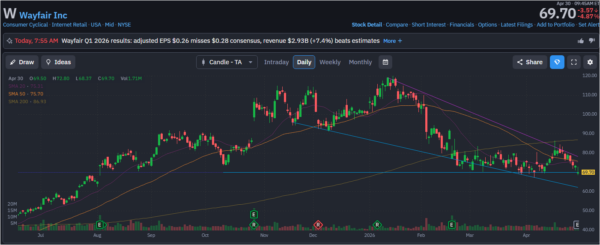
Roughly 40 minutes after the open, Wayfair stock dropped from about $73 to $69, and that move wasn’t random noise from the open. It was the market quickly recalibrating what the earnings actually meant once the first wave of orders cleared.
The initial push higher reflected the surface: revenue up 1.6% and orders up 2.8%. But the follow-through failed almost immediately, and price reversed as participants leaned into the underlying reality – average order value down 1.1% and margins sitting at 4.3%, which points to growth being driven by pressure, not strength. That kind of move doesn’t come from uncertainty. It comes from fast disagreement with the initial read as the market corrected the narrative.
This Is Not a Clean Story, But It Matters
All told, what you’re left with is a business that is growing while the category remains weak, doing so through higher activity rather than higher spending, and accepting tighter margins as the cost of securing that position, all while expanding into physical retail and strengthening its control over how customers find and engage with its platform.
Numerically, revenue is up 1.6%, orders are up 2.8%, customers are up 1.4%, and average order value is down 1.1%, which is not the profile of a company riding a recovery but of one executing inside constraints.
That distinction is the entire story, because growth in a strong market is expected, while growth in a weak one is earned, and what Wayfair just showed is that it can operate – and expand – without the market doing the work for it.



Tidak ada komentar:
Posting Komentar