The Fed Is Finished VIEW IN BROWSER 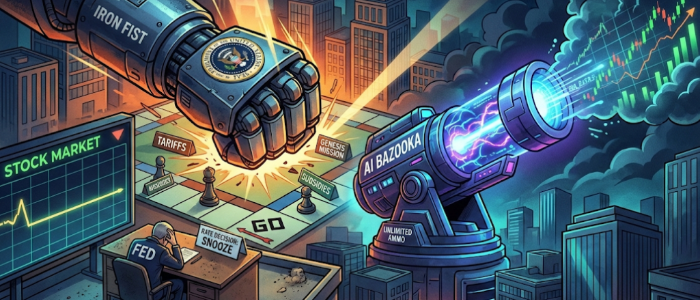
Something unprecedented just happened. The Federal Reserve made its first rate decision of 2026… and the markets didn’t even flinch. No rally. No selloff. Nothing. Just a few years ago, it seemed Fed Board Chair Powell could send the Nasdaq on a 3% ride with barely a syllable. Now… crickets. The 3.5%-3.75% range hold barely caused a blip on trading screens. So, what happened? When did the most powerful economic force in the world become irrelevant? When the ‘invisible hand’ died and was replaced by an ‘iron fist’; one that’s rewriting every rule of capitalism as we know it. Here’s what’s really controlling the markets now – and how to make the most of this shift. Why the Federal Reserve Lost Control of the Markets For decades, the Fed controlled everything. It set rates, and the market responded. But over the last year, that guiding hand has been replaced by the very visible, very heavy iron fist of the government’s executive branch. And this new regime – which we'll call the Technological Republic – isn’t subtle. The government isn’t waiting for monetary policy to work its magic. It’s picking up the phone and deploying billions directly. Three strategies show it: - The Tariff Carrot-and-Stick: The White House announces sweeping reciprocal tariffs, then turns around and cuts bespoke deals with specific U.S. companies to skirt them.
- Washington Becomes Venture Capital: Instead of waiting for the Fed to lower the cost of capital, the government is just handing it out via massive investments, as we’ve seen with MP Materials (MP) and Intel (INTC).
- Picking Winners in Real-Time: Just days ago, on Monday, Jan. 26, 2026, the Department of Commerce announced a staggering $1.6 billion funding package (under the CHIPS Act) for USA Rare Earth (USAR) to build out a domestic magnet supply chain.
Think about what this means. When Washington can deploy $1.6 billion to a single company in a single week, what’s a 25-basis-point rate cut worth? The executive branch has seized control. Nobody’s watching the Federal Reserve’s dot plot anymore. Now all eyes are on 1600 Pennsylvania Avenue, waiting to see which company gets the next billion-dollar ‘Golden Ticket.’ AI Spending Ignores Fed Interest Rates But the government takeover is only half the story. There’s a second force making the Fed obsolete – and this one is purely technological. We’re in an AI spending super-cycle that doesn’t care about interest rates… at all. In a normal economy, high rates kill spending. Companies pull back. Investors get cautious. But AI isn’t normal. It’s an arms race – and nobody’s slowing down AI companies were spending when interest rates were rising in early 2023… when they were at their peak in ’24… when they were falling throughout ’25… And they are still spending here in 2026 as rates remain steady. Big Tech is firing an AI bazooka with seemingly unlimited ammo. These companies are sitting on mountains of cash and generating “supercharged” earnings growth that a 25-basis-point move by the Fed wouldn’t move the needle on. No matter what Powell & Co. decide, the data centers are getting built, the GPUs are being shipped, and the AI stock returns are following the earnings, not the interest rates. Which brings us to the final nail in the Fed’s coffin… The Fed’s Lame Duck Problem: Powell’s Last Stand Here’s the uncomfortable truth nobody’s saying out loud: Jerome Powell is a lame-duck Fed chair, and the market knows it. The White House has made no secret of its desire for aggressive rate cuts; and with Powell’s term as chair ending this May, the market is already looking past him. The administration is expected to appoint a new Fed chair later this year; someone who will almost certainly be more “aligned” with its own vision. As such, we’re likely to see multiple rate cuts in the second half of 2026 – not because the “data” demands it, but because the new regime does. The Only Question That Matters Now So… The Fed? Irrelevant. The “invisible hand” of free markets? Dead and buried. What’s controlling asset prices in 2026 is simple: Washington’s iron fist and whoever it decides to write checks to. And right now, that fist is wrapped around one singular obsession – the Genesis Mission. This is the White House’s bet-the-farm initiative to dominate global energy and AI infrastructure. And it isn’t some five-year plan buried in a think tank white paper. The money is moving right now. USA Rare Earth: $1.6 billion, announced just this week. Intel: Billions in CHIPS Act funding, already deployed. MP Materials: Federal backing secured, with new plants to come. These companies are watching government capital flood their balance sheets while their competitors scramble for venture rounds. And this is just the opening act. The Genesis Mission has six core infrastructure layers it needs to build. Each one represents hundreds of billions in capital deployment. Each one has a shortlist of companies positioned to capture the lion’s share. I’ve spent the last three months identifying them – the names that will define the next market cycle. This is the biggest wealth-building opportunity I’ve seen since the early days of the AI boom. But the difference is that this time, we know exactly where the capital is going before it gets there. Watch my Genesis Mission briefing now to find out everything I’ve learned. Sincerely, | 





Tidak ada komentar:
Posting Komentar