Getting your face ripped off by the stock market can have a sobering impact on a fella. |
Like most investors, I've made my fair share of truly dumb decisions. However, unlike most investors, I made those terrible decisions with everything I owned and more (borrowed money). |
When you lose all your money, life can go one of two ways. |
You can wallow in self-pity and never recover. Lots of folks choose this road. |
Alternatively, you can stand up, brush yourself off, look in the mirror… take stock of what you did wrong… make changes… and start all over again. |
I spent almost two years wallowing in self-pity before I made the decision to get up off my rear and learn from my mistakes. Looking in the mirror at your own foolishness might be the most difficult thing we ever do as investors. |
But if you want a life better than the one you now have, you must understand that the only person who can provide that life is YOU. And if you don't yet have the life you want, it's because YOU are doing something to prevent it. |
I have arguably helped more people become millionaires than any other newsletter writer in this industry. Along the way, I have created more wealth for myself than at any other point in my life. |
In this essay, I am going to share with you the wealth-making formula I used (and continue to use) that transformed my loyal subscribers and me from stock market losers into wealthy, world-class investors. |
The Power of Asymmetric Investing |
Most folks know me for my pioneering work in crypto assets. I was the first person in the newsletter world to recommend bitcoin and Ethereum back in April 2016. Since then, they've seen peak gains of 29,971% and 54,344%, respectively. |
I call these types of ideas "asymmetric" risk plays. |
The idea behind asymmetric investing is simple: You risk a small amount of capital for the chance to make life-changing gains. The gain is asymmetrically larger than the potential loss. |
For instance, readers who invested $1,000 in one of my top crypto picks, NEO, had the opportunity to see peak gains of $1.5 million. But the real lesson isn't the extraordinary return – it's that we risked very little capital in that idea. |
Now here's the part most people don't get: As powerful as asymmetric ideas can be, they can't make up your whole portfolio because they can – and sometimes do – go to zero. |
What I learned was that if I wanted this approach to work, I needed my feet planted on a solid foundation. |
That's why the base of my own portfolio is built on "boring" blue-chip stocks that pay reliable dividends. I reinvest a portion of that dividend income into high-upside asymmetric risk ideas that turbocharge my wealth even further. |
In a moment, I'll show you how a specific group of these companies are using artificial intelligence (AI) to become the profit machines of tomorrow. |
They're writing AI's next chapter. This is the chapter that goes from building AI (think Nvidia) to the companies using AI at scale to drive billions of dollars in cost savings. |
I believe the investors who own them will become the newest members of my asymmetric millionaire subscriber cohort. |
First, I want to show you how to build your own self-funding, income-generating wealth machine from these overlooked companies that are leading the way in AI usage. |
Building Your Own Self-Funding Wealth Machine |
Every dollar of my earned income first goes into income-producing assets – like the handful of blue-chip stocks that are about to emerge as AI's biggest winners. |
That approach keeps my principal protected while generating an ever-growing stream of income I can redirect into even higher-upside asymmetric risk ideas. |
If you don't interrupt this process, compounding alone can produce a fortune. |
It's similar to the snowball effect. |
As you roll a snowball through the snow, its surface area grows. The larger it gets, the more snow it picks up. At first, the progress feels slow. But eventually, the snowball becomes so large, you can't stop it. |
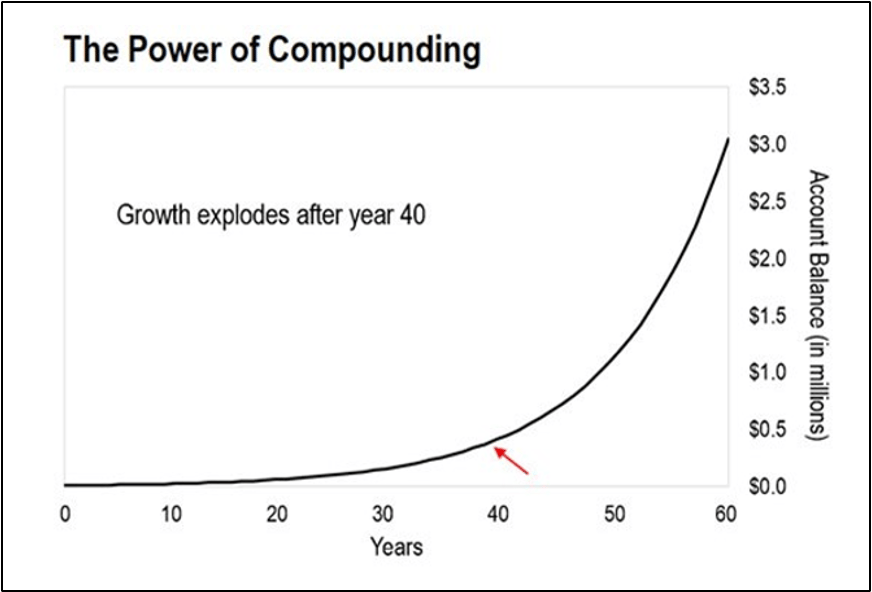
That's exactly how compounding works. At a 10% annual return, it takes about 40 years for a $10,000 account to grow into roughly $450,000. |
That's solid. But look at what happens next… |
|
By year 50, it grows to more than $1.2 million. And by year 60, it exceeds $3 million. |
That's great, but we don't have 40, 50, or 60 years to sit around and wait. So here's what we do instead… |
The real power of compounding shows up when you buy the best income-producing companies – and carve off a portion of their income into asymmetric risk ideas. |
Think about this... |
A $100,000 portfolio growing at 10% per year and throwing off $4,000 a year in income (reinvested) for the last 10 years would be worth $329,000 today. |
That's great, but that's not how you get rich. Here's what my subscribers and I did differently. Instead of reinvesting that $4,000 per year back into more blue-chip stocks, we bought bitcoin. |
Had you taken that simple step, you would have over $1.2 million today. That's even after bitcoin's recent 30% drop. |
This is what I call your Self-Funding, Wealth-Compounding Machine. It's the engine that powers your entire wealth plan. |
Even if I had been 100% wrong on bitcoin, my core blue-chip assets would still have been compounding at about 10% per year. I still would have had at least $259,000 in total value in my portfolio. |
That's how you make life-changing wealth without taking life-changing risk. |
Your core portfolio of income-generating assets funds your asymmetric bets like bitcoin and NEO. Your asymmetric profits flow back into your income portfolio, which boosts your dividend income, which boosts the amount of money that can be deployed into asymmetric bets. |
Simply put, that means the core portfolio is generating even more income to redeploy into more asymmetric ideas. That's what I mean when I call this a self-funding money machine. |
And here's the real advantage of this approach… |
Even in a worst-case scenario in which your asymmetric investments fail, your overall net worth remains largely intact. Within a year, your income is replenished as your "boring" investments continue doing what they do best – generating income. |
This is how I've turbocharged my wealth – without turbocharging risk. |
The beauty of this approach is we don't have to wait 40 years for traditional compounding to work in our favor. My method gives results that move the needle today. |
The key to this whole approach is having a portfolio of safe foundational assets that will power the entire wealth engine. |
That's why I've been scouring the market for the blue-chip companies that will be writing AI's next chapter, the chapter of AI usage. |
The Most Exciting Idea in the Market is Being Ignored |
Right now, the most popular trend in the market is artificial intelligence (AI). |
But I don't believe the biggest gains moving forward will come from hyped-up, overvalued Silicon Valley darlings like Amazon, Microsoft, or Nvidia. |
Don't get me wrong, these are still great companies. They're just incredibly expensive. The "hot" AI stocks are on average trading at about 70x sales. |
However, my research suggests the biggest gains will come from the companies deploying AI at scale in their businesses to become more efficient. |
I'm talking about inexpensive (trading at 2-3x sales), mostly forgotten blue-chip companies that are quietly using AI to transform slow-growth business models into profit volcanoes by radically cutting costs. |
Think about it. |
Legacy blue chips are burdened by bloated infrastructure, massive employee overhead, and decades of legacy costs. AI will rewire all of that – and fast. |
From automated customer service… to AI-enabled inventory tracking and loss prevention… to training, logistics, and operational automation… |
These old-fashioned, backbone-of-America corporate giants are positioned to become the biggest winners of the AI revolution. |
Many of these blue chips already pay 4-5% dividend yields. As AI boosts efficiency and cash flow, I expect over time, those dividends could double – or even triple – creating an even more powerful snowball effect. |
Best of all? None of that is priced in yet. |
The narrative of buying blue-chip stocks to profit from AI hasn't taken hold. That's why these stocks are still cheap – and why this opportunity exists today. |
The market still sees them as no-growth relics. Their massive usage of AI will prove otherwise. |
After months of vetting this idea, I'm finally ready to launch a new service designed specifically to help everyday investors like you target the biggest winners in the next chapter of the AI story – before the market catches on. |
Hundreds of thousands of subscribers are reading this right now. To be first in line to get access at my best launch price, hit reply to this email with the words "I WANT IN." |
Friends, asymmetric investing is how I've created life-changing gains for myself and tens of thousands of my subscribers. |
And I've funded it through buying income-producing blue-chip companies – and letting the income I generate from them compound in asymmetric bets. |
That's where these AI companies come in. |
They pay you a steady income today… while AI quietly accelerates their earnings and dividend payouts tomorrow. |
Remember: To be one of the first in line to get access at my best launch price, hit reply to this email with the words "I WANT IN." |
Let the Game Come to You! |
Big T |
|
|
|




Tidak ada komentar:
Posting Komentar