March 6, 2026
The Tractor King Isn't Who You Think It Is
Dear Subscriber,
 |
| By Michael A. Robinson |
It’s hard to imagine AI improving something seemingly so “non-tech” as the humble tractor.
After all, it’s a simple, diesel-powered machine designed to move dirt.
Hardly a tool that is begging for AI intervention.
Steel, wheels, horsepower — this is about as low-tech as it gets.
Yet funny enough, the assumption that AI can’t play a role in an industry is what many investors get wrong about the AI Supercycle.
You see, AI isn’t just transforming cutting-edge sectors like software and chip-making.
It’s reshaping the entire global economy, including “low-tech” agricultural equipment.
A tractor is no longer just a piece of heavy machinery. With AI, intelligence is built in — which improves efficiency, lifespans and crop yields.
And that’s how the AI revolution actually spreads. Not all at once, and not always where people expect it.
But it’s in these overlooked areas, where some of the best money-making opportunities can be found.
That includes one company whose role with AI isn’t being used on screens and data centers …
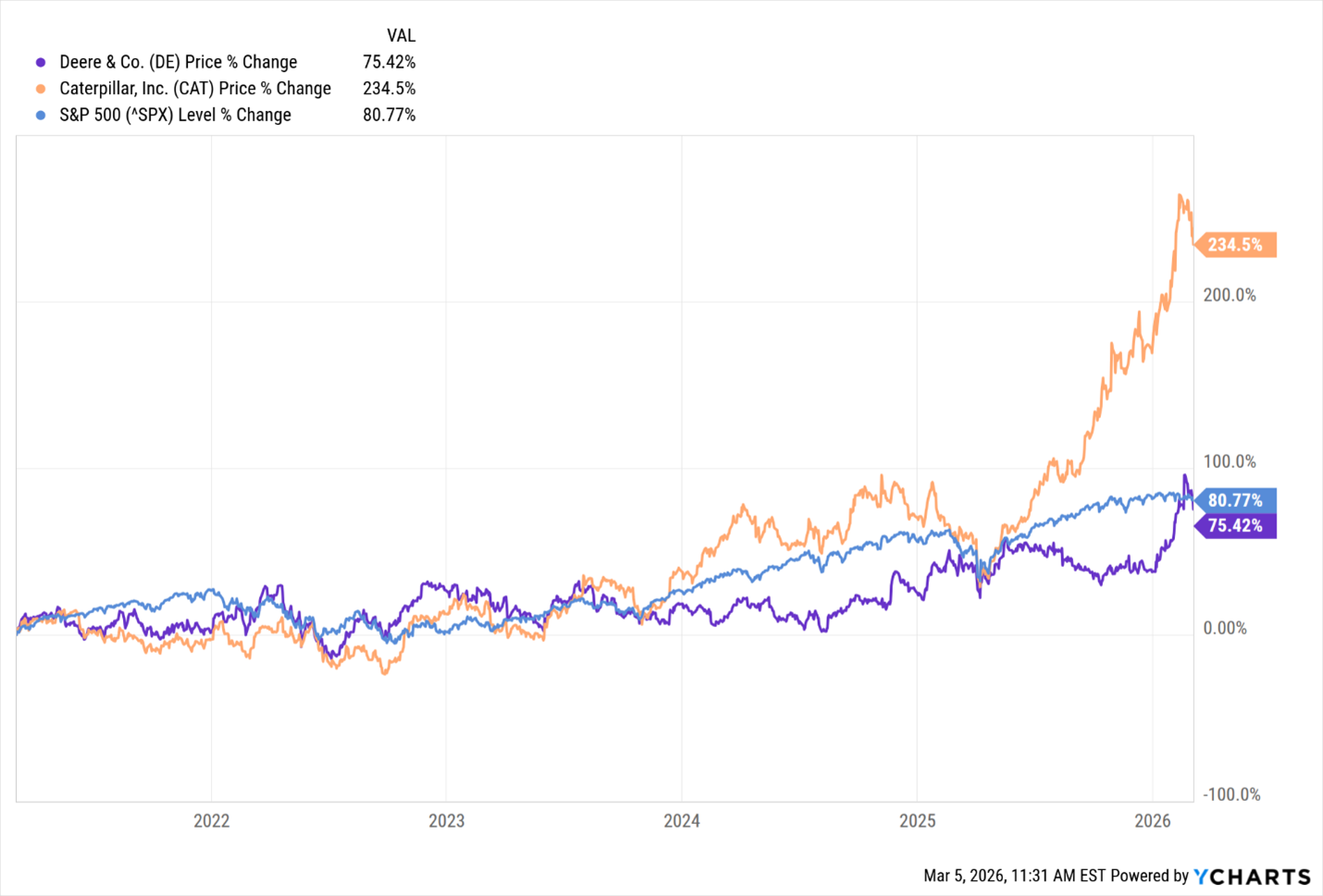
A company whose shares have roughly tripled over the past five years …
A company with plenty of upside ahead.
And no, it’s probably not the one you are thinking of.
Not Your Granddaddy’s Tractor
Today’s heavy equipment features digital systems that improve efficiency, safety and precision.
They’re equipped with GPS-guided controls, 3D machine-control systems and real-time telematics.
These enable operators and fleet managers to monitor things like performance, fuel usage and machine health.
I’ve talked about this before.
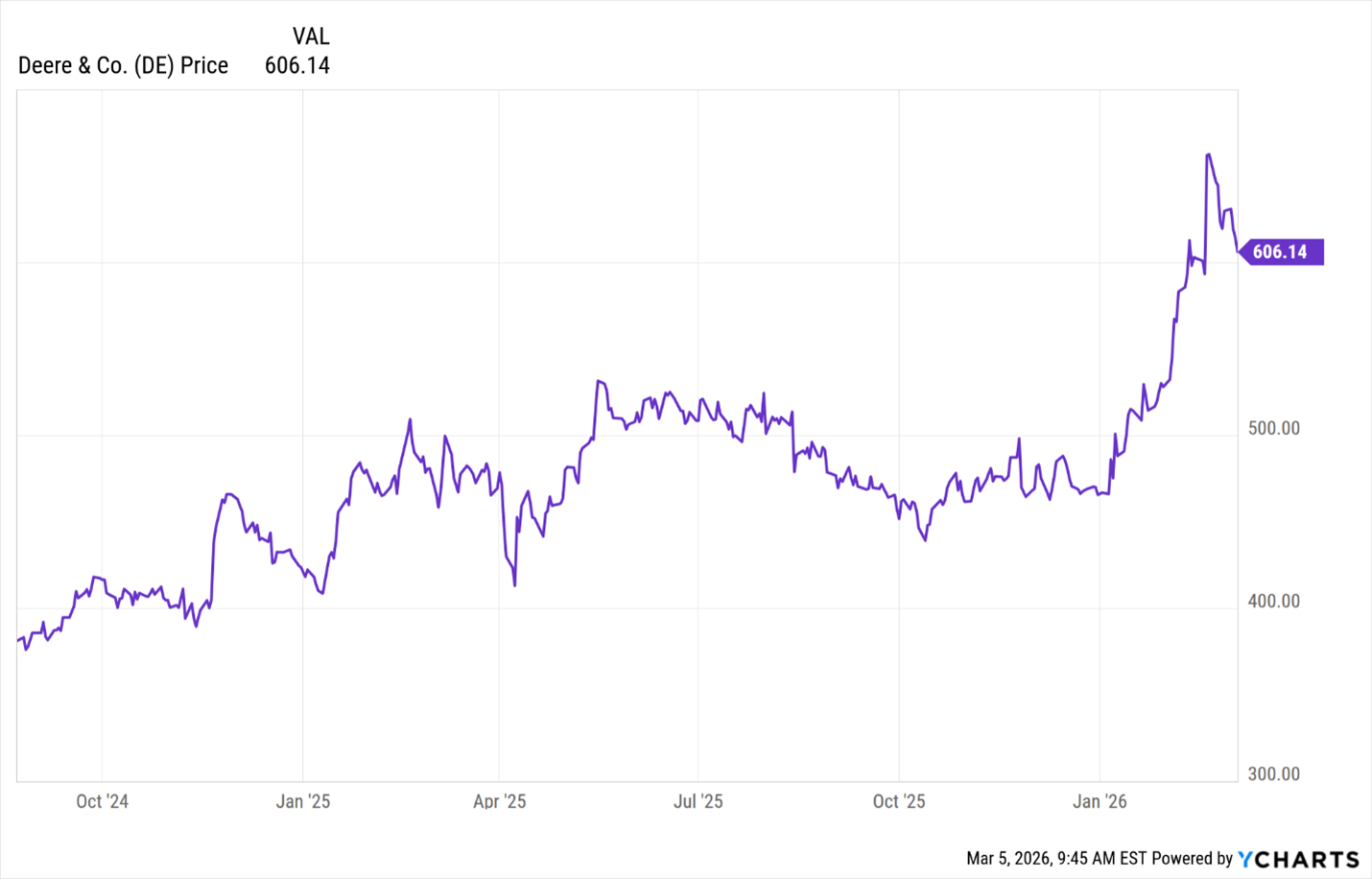
In 2024, I noted that Deere & Co. (DE) was on the forefront of using satellites to improve farmers’ yields.
Since that article, it’s done well:
But that’s not the company I want to talk about today.
No. There’s a different …
King of AI Tractors
Caterpillar (CAT) is one of the world’s largest and most recognizable manufacturers of construction and heavy equipment.
It traces its roots to the 1800s.
That’s when Benjamin Holt and Daniel Best independently developed early track-type tractors designed to work in soft farmland.
Their companies merged in 1925 to form Caterpillar, a name inspired by the machines’ caterpillar-like tracks.
Today, the company designs, manufactures and sells a range of equipment.
This includes excavators, bulldozers, wheel loaders, motor graders and backhoe loaders.
Beyond construction machinery, it produces engines, turbines and power systems.
These are used in energy, transportation and industrial applications.
Caterpillar operates in more than 180 countries and employs more than 100,000 workers worldwide. Annual revenue comes close to $70 billion.
This impressive figure is thanks in part to the company’s history of focusing on innovation.
Sure enough, it’s continuing to do that now that AI is here …
An Under-the-Radar AI Play
When you hear the name Caterpillar, you probably picture massive yellow bulldozers and excavators moving around construction sites.
To be sure, that’s still a huge part of its business. But behind the scenes, the firm has become vital for the AI buildout.
Not because it’s building chatbots or chips, but because AI needs power — lots of it.
As AI data centers multiply, they’re straining local power grids. That’s where Caterpillar comes in.
There’s been a surge in demand for its generators and power systems.
Data center operators use these to ensure reliable, always-on electricity.
The firm’s natural-gas generators provide more than just backup power.
They’re essential infrastructure that keeps AI workloads running smoothly when the grid can’t keep up.
This growing demand has become one of Caterpillar’s strongest growth drivers.
A notable example is the company’s involvement in large-scale AI data center projects.
Many require gigawatts of power capacity. These facilities need fast-response energy systems that can handle sudden spikes in computing demand.
Caterpillar’s generator technology, combined with advanced digital controls, fits that need well.
But Caterpillar is using AI internally, too.
The company has AI-driven tools that help customers monitor equipment health, predict maintenance issues and troubleshoot problems faster.
This company is helping power the physical backbone of the AI economy, while quietly embedding AI into its own products … including its tractors.
It has a major role in the AI Supercycle. And sure enough, Wall Street has taken notice.
Growth Ahead
Earnings growth is on the rise. For this year, it’s forecast to hit 20%.
That’s faster growth than Apple (AAPL). And when earnings climb, stock prices tend to do so as well.
That’s certainly been the case here.
As you can see, it has more than doubled DE and the broad market over the past five years:
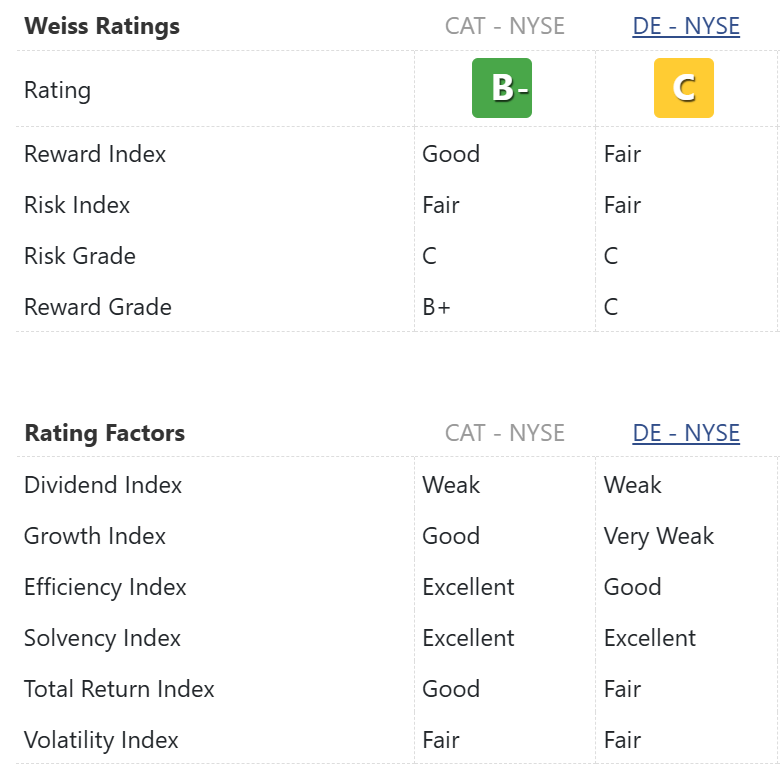
The Weiss Ratings prefers CAT right now, too:
It scores a “Buy” rating, whereas DE has fallen to a “Hold.”
CAT also scores better on its Reward Grade, as well as our proprietary Growth, Efficiency and Total Return indices.
So, yeah, I’d say CAT is the current AI Tractor King!
Best,
Michael A. Robinson
P.S. Still, you can’t ignore CAT’s other major business lines, including its mining equipment, which are in hot demand with gold’s remarkable rally.
But you don’t need a $12 million CAT 6090 FS hydraulic excavator (yes, really) to get a piece of that action.
And my colleague, Chris Graebe, found a pre-IPO company that doesn’t need that kind of equipment either for its own gold operation …
Watch his interview here for more.



Tidak ada komentar:
Posting Komentar