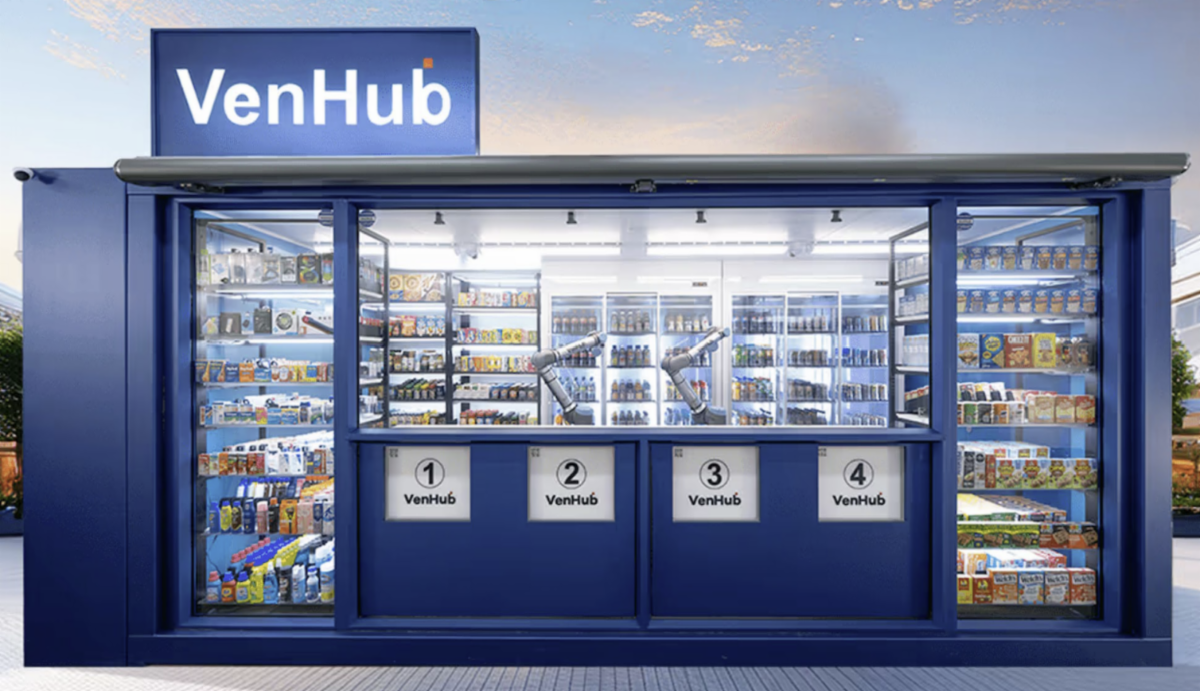
| Customers interact primarily through their phones: they browse a digital catalog, place an order, pay securely, and then watch items appear at pickup windows as robotic arms and back-end systems do the work.
VenHub has described transactions being completed in as little as 90 seconds, positioning the experience closer to a compact, robotic micro-fulfillment center than a vending machine.
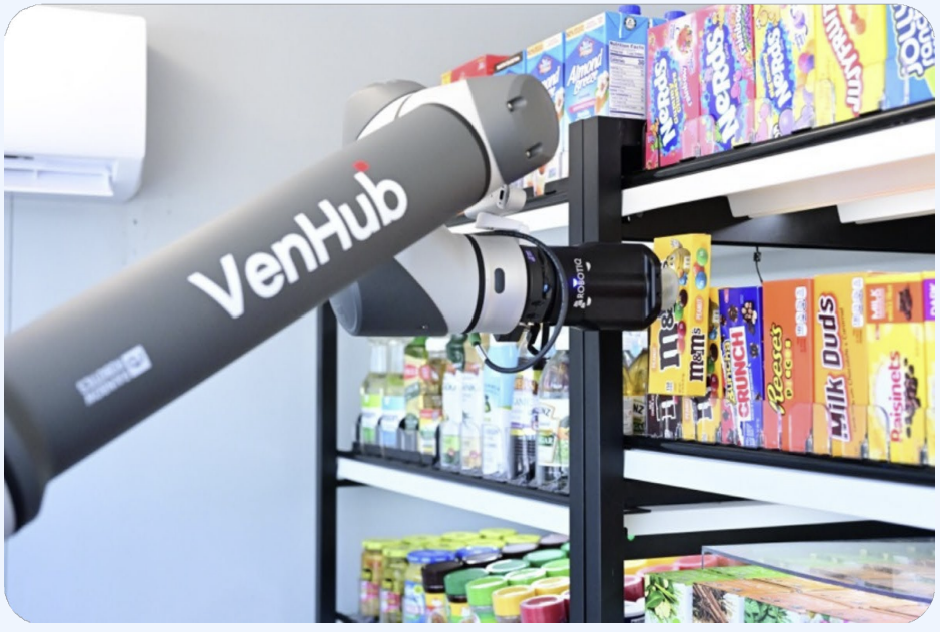
Behind the scenes, the company highlights a full loop: merchandising, ordering, picking, dispensing, and inventory optimization coordinated by software, with robotic arms (nicknamed Barb and Peter) executing the physical handoff.
VenHub’s format is designed to tackle two of retail’s biggest structural pressures—hours and overhead—along with persistent shrink.
Traditional stores face a tradeoff: closing early caps revenue, but staying open late drives up labor costs and exposes operations to more loss and security challenges.
Shrink has become a major drain across the industry, forcing retailers to shorten hours, lock up products, pull items from shelves, and hire additional security just to protect the same sales base.
According to the National Retail Federation, industry losses from shrink reached approximately $112.1Bn in 2022, with an average shrink rate of 1.6% for the fiscal year.
This figure is significant not because it represents a single, isolated cost, but because it persists.
It shows up continuously—affecting every aisle and every location—pushing retailers toward defensive decision-making.
At the same time, retail wages and scheduling complexity add friction even as average hours per worker remain constrained.
VenHub’s autonomous model attacks these constraints directly by allowing a store to stay open all night without late-shift staffing, while running a tightly monitored, access-controlled environment that can reduce reliance on reactive loss-prevention measures.
This is where VenHub’s focus on specific locations comes into play.
The company has targeted transportation hubs as its first major beachhead, places where people flow is heavy, hours are long, and staffing and security are especially challenging.
A 24-hour VenHub Smart Store at the LAX Metro Transit Center shows how the format behaves in a high-traffic, unpredictable environment, serving passengers and staff around the clock.
A second location at Los Angeles Union Station, one of the nation’s busiest transit hubs with over 600,000 daily passengers, carries over 400 essential products and demonstrates that autonomous convenience can sit directly inside major public corridors.
In both cases, demand is already present; VenHub’s contribution is uptime, access, and a format that remains viable when human-operated stores would struggle to stay open.
The company has treated public validation as a key step.
At CES 2026: VenHub ran a fully operational autonomous smart store on the show floor, not as a concept booth but as a live environment where attendees could buy from hundreds of products through their phones and watch automated fulfillment in real time. | 


Tidak ada komentar:
Posting Komentar