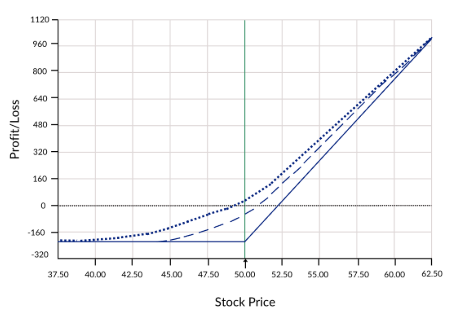
| Hey there, it’s Micah here… Last month, I hosted the 10X Option Workshop. Many people loved it, but I also heard from traders who felt it was too advanced. So today, I’m sharing my notes on options, starting from the very beginning of trading them. We’ll start at the foundation and cover the leverage points of call options, what they are, how strike price and expirations work, and why they matter. Why I Use Options Leverage lets you make a lot of money fast. But it also means you can lose fast. We call this directional leverage, it gives you limited downside risk and unlimited upside. Directional leverage is measured by the option Greek called Delta.
How to Get 30X the Delta Suppose I think AAPL is going to rise over the next few weeks. I can buy a call option that gives me bullish exposure for that entire period. Right now, this would cost less than $500 and provide me with about 50 Delta. To match that same 50 Delta with stock at $300 per share, I’d need to buy 50 shares, which would tie up $15,000 of capital. With the option, I’ve gained the same directional exposure for a fraction of the cost. That’s the first step in understanding the real power of options: capital efficiency and leverage. So one call option gives you the same exposure with 30X less capital. This is why I love options. And it’s why I get emails like this one:
Two Key Variables 1. Strike Price 2. Expiration The Journey Ahead Tomorrow, we’ll review the next step: put options and the three main ways they’re used. One may surprise you. Trade On, PS. Every great strategy we teach starts with these fundamentals. Tomorrow we’ll dive into put options, the other side of the coin, and explore how traders use them for protection, income, and profit. Once you see both calls and puts, you’ll be ready to start building your own trading plan.
Micah Lamar Questions? Please email us at Support@WallStreet.io or Chat with us 1-on-1 at WallStreet.io WallStreet.io All Rights Reserved © 2024 Thank you for being a part of our community. Please use the social links below and spread the word. We appreciate you! Thanks in advance.
|

Tidak ada komentar:
Posting Komentar