Previously:
Before we jump into the deep end, a brief word on Caplight.
Caplight shines truth on private company stock prices. One subscription to track all datapoints in the secondary venture capital market. Trade the private markets with ease. Book a demo here. The bulls were everywhere. To say it was out of style to be a bear was a massive understatement. A few brave contrarians stepped forward and expressed their concern with the state of the market. Barton Biggs, chairman of Morgan Stanley Asset Management at the time, knew the market was grossly overvalued and completely divorced from stock fundamentals.
While every brother-in-law wasn’t necessarily starting hedge funds, they were definitely trading online. In July of 1983, a doctor from Michigan made history when he was the first person to execute a trade virtually using E*TRADE. It wasn’t until 1992 that the company would officially take on its name and a few years later, it would start to see serious traction. By the end of 1995, it had 40K users and was executing 4K trades a day. By the summer of 1996, the number of users had swelled to 800K. The Motley Fool, founded by brothers David and Tom Gardner, also became extremely popular, as people began to devour the latest analysis on their target stocks. E*TRADE and The Motley Fool soon went hand in hand like PB&J for online retail investors. Thus an interesting loop was created: the Internet begins, Internet stocks boom, and people use the Internet invest in said Internet stocks. More specifically, many people not only began trading stocks, but also began day trading. Marc Friedfertig, founder of Broadway Trading, describes the art / science of day trading at one of his conferences:
Seemed easy enough. But the thing is, the guys at the conference didn’t want to be the guy who walked away with $50K. They wanted to be Serge Milman, who grossed $1.4M and pocketed $800K after commission. The obvious reality with making $50K or $800K day trading is that there is a high level of risk involved. Many more people lose money day trading compared to those who make money. And for those who lose money, the end result isn’t always pretty. Take Mark Orrin Barton for example. His life was pretty normal on the outside looking in: he lived in the suburbs of Atlanta, was on his second marriage, and had two kids. He began trading in 1998, but by April of 1999, he’d racked up a decent chunk of losses. By early June, his account got shut down. He shifted to a different platform called Momentum Securities where he claimed to be worth $750K and wrote a check for $87,500 to open his account. He quickly lost $105K after borrowing even more capital on margin. He inevitably got slapped with a margin call and his account was closed after he couldn’t come up with any more money. After hearing the check he wrote bounced, he went home and brutally murdered his wife and two children. Soon after, he drove to the Momentum Securities office and killed four people and wounded several others before taking his own life. Although this was undeniably a one-off event with poor timing of the market, many people bought into the idea that day trading during this time was as easy as printing money right off the press. The media played a massive role in this. In general, the media’s role is to discuss topics by presenting both sides of the coin so that the public can make an independent and rational decision with the information. During this time, the financial media space did the opposite, as those critical of the market’s valuation were either ignored, slowly deplatformed, or simply drowned out by the ubiquity of the bulls. When watching CNBC, for instance, during this era, the only conclusion one could logically conclude was that if you weren’t invested in tech stocks, you were missing out.
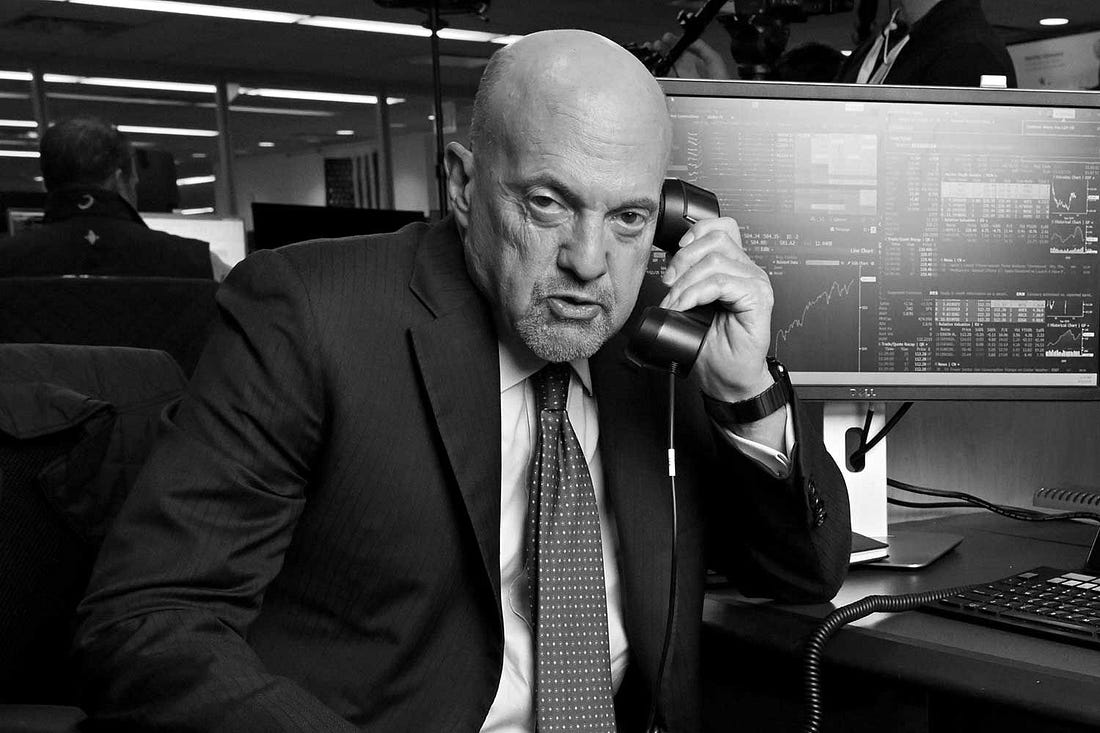
No one had a larger influence on financial media than the one and only James Joseph Cramer.
Jim Cramer was raised in the suburbs of Philly and attended Harvard. One day, a professor named Marty Peretz asked Cramer to write a book review on markets, and eventually began taking some of Cramer’s stock tips. After seeing some of his ideas materialize, he cut him a check for $500,000 and told Cramer to make something happen. Two years later, Cramer came back with $1.5M. After briefly trading equities at Goldman, he quit his job and cofounded a hedge fund that returned 22% between 1988 and 1996. During this time, he wore the hat of both an investor and journalist, contributing regularly to publications like GQ and The New Yorker. For those wondering: yes, one can argue this presents a conflict of interest. For instance, he publicly recommended four stocks when writing for Smart Money without disclosing that his fund owned significant stakes in the companies. Once the piece was released, his fund’s stake in the companies increased by $2M. After an investigation, he beat the case. When it came to tech stocks, no one was a bigger advocate than Mr. Cramer. In his eyes, the only problem with Internet stocks was that “we simply don’t have enough pieces of paper that represent the right to own future profits from the ‘net.” Cramer, along with the rest of the media, continued to blow the FOMO horn and capital continually poured into the market. The New York Times began to report that it was common for UPS and taxi drivers to be trading tech stocks their laptops and portable quotation machines. Alan Greenspan, the Fed chair, saw this and knew the market was officially a bubble. He’d had the feeling for a while but wasn’t sure what to do exactly. If the overall economy was overheated and inflation was picking up, then everyone would be on the same page: increase rates, burst the bubble, and bring everyone back down to Earth. But that wasn’t the case. Everything was going a little too well. Inflation was low, the labor market was strong, GDP growth was north of 4%, and the market was outperforming all three. Although it was clearly a bubble, was it Greenspan’s responsibility to single-handedly cut the music and end the party? His laissez faire instincts whispered that it in fact was not. Greenspan seemed to relish in the idea that he seemingly held the global financial world in his hands. The duties and responsibilities of the Fed chair had not materially changed relative to previous decades, but many identify him as the catalyst for the Fed chair becoming more of a public figure. After speaking with mainstreet media, John Murfee, a financial services expert with 40+ years of banking and trading experience, agrees wholeheartedly:
Greenspan had decided that the fiesta must draw on; for everyone except the contrarians of course. Bears went from being few and far between to essentially extinct, especially those with a financial manager or investor role. Not only did their credibility suffer as stocks continually climbed higher, but their performance severely lagged behind relative to the herd. There were many stories like Charles Clough, a Merrill Lynch stock strategist, who, after pleading with his investors to keep their money in cash and bonds because equity valuations were too high, saw his performance at the bottom of a Wall Street Journal survey performance. He made the decision to spend more time with his family and become a deacon full time for his local Catholic church. As more bears went extinct, more people began to flood the startup scene, as the incentive to join or found a startup was at an all-time high. An anonymous HBS grad that founded an Internet company in the fall of 1999 describes the process of entering the founder space:
Tom Gardner, co-founder of the Motley Fool, echoes a similar sentiment. In an exclusive sit-down with mainstreet media, Gardner explains just how hungry VCs were for up-and-coming businesses.
Being a founder was now the hottest job on the market. Michigan’s business school had just started a new course called “From Idea to IPO in 14 weeks,” and HBS’s survey indicated that more students (343) were planning to join a tech startup than management consulting or finance (308). VCs were willing to throw money at whoever as long as “they thought you were smart” because of how easy it was for companies to go public. The entire ecosystem incentivized a reckless bombardment of cash in every direction because founders knew VCs wanted to deploy at a fast rate, as bankers would underwrite the IPOs without even thinking twice—as long as it operated on the web. Even better, once the company would go public, the stock would pop on the first day as investors’ demand for internet stocks seemed to be insatiable. Founders were worth millions in the blink of an eye. VCs realized unbelievable gains. Bankers were raking in cash from underwriting fees hand over fist. Public market investors were living the dream. Again, all of these companies had minimal revenue, excessive losses, and no concrete guidance for investors as to when they would become profitable. Most companies explained this away, loosely conveying a plan similar to Amazon’s “winner-take-all” model in which they would aggressively spend to offer below equilibrium prices and eventually worry about profits down the line. On December 31st, 1999, Muhammad Ali rang the opening bell on the NYSE, and when it closed, the Dow was up 25% and the NASDAQ was up 86%, surpassing the Dow’s 81% performance in 1915 as the highest major index performance of all time. Don’t let that slip through - NASDAQ did hedge fund numbers… 86% from an index is unheard of. What a time to be alive. But as we know, good times can’t last forever. As Isaac Newton famously proclaimed, “What goes up, must come down.” The come-down wasn’t as simple as raising rates and watching the economy and market slow down. By the time 2000 rolled around, there were whispers that Greenspan was indeed thinking about raising rates not to interfere with the market’s unsustainable run but to get ahead of potential inflation. Like mentioned previously, inflation was under control but Greenspan was nervous, as demand was rising much faster than supply and guessed it was only a matter of time before inflationary pressure manifested. By the time March rolled around, rates had increased from 5.5% to 6%, and investors mainly shrugged it off. But other than the rates, the overall sentiment was beginning to shift just a bit. Sometimes, that all it takes. Jack Willoughby wrote a piece questioning whether the bubble would burst soon, and teamed up with a notable research firm called Pegasus Research International to examine the financial statements of more than 200 internet companies. After some basic analysis, he concluded that over a quarter of them would have no cash in the next year based on their current burn rate. Around the same time, Business Week ran a piece accusing Wall Street of peddling high risk investment strategies to the public. Another writer named Mark Mobius at Templeton Mutual Fund Group suggested that the mania for Internet stocks is coming to an end. Simply put, “if you look closely enough, it’s beginning.” By the turn of the next month, the market continuously trickled downwards. The drop was large enough that many investors faced margin calls and needed to sell some of their stocks to combat this. The NASDAQ would soon drop 600 points. At this point, it wasn’t clear whether the beginning of the end had truly arrived or if it was just a minor dip that could be capitalized on. On April 10th, the NASDAQ dropped 6%, and just two days later, after Rick Sherland–a well-respected Goldman Sachs equity analyst–lowered Microsoft’s revenue expectation, the exchange dropped 7%. It was at this point that Cramer, along with the rest of the investing world, knew the party was officially over.
By the end of the year, the NASDAQ was down 40% for the year with Microsoft losing 63%, Amazon losing 77%, Yahoo losing 86%, and Priceline losing 97%. Gardner gave us an inside look on how the crash affected The Motley Fool:
The Motley Fool managed to stay alive, but many of its dot com counterparts were dead upon the arrival of the crash. Webvan was the most notable, as the online grocery store that raised $800M, went bankrupt in the summer of 2001. By Q2 of 2001, the effects began to spill over into the real economy, as the it expanded by just 0.2%. By September, the exchange was sitting at $1687, down from its peak of over $5100. It was during this time that the 9/11 attacks occurred and the Twin Towers came crashing down. The idea of American economic and militaristic invincibility had come crashing down as well. Fast forward to today, and it is hard to ignore the whispers. “The AI bubble is bound to pop any day now.” “P/E ratios are higher now than they were during the Dot Com bubble.” “History seems to be repeating itself.” There is some truth to the whispers. It doesn’t take a genius to realize that the equity market is overvalued and has largely been driven by AI hype. Since January of 2023, the S&P’s gross return is roughly 77%. Thus, we seem to be in the same situation as the early 1990s: bulls believe that a revolutionary technology has been introduced that will seemingly increase productivity and thus future profits. Because of this, we should be willing to pay a higher price for today’s earnings given their future growth rates will increase. Bears believe that the hype of said new technology is overblown and equities have become too expensive because of this. Similarly, companies’ stocks are being rewarded for simply signaling they are going along with the new trend. Instead of mentioning the incorporation of the Internet into their operations, companies are telling investors they will increase AI expenditure and are receiving rounds of applause in response. So what’s the difference? Murfee explains a major one:
Murfree makes an excellent point. But, public market AI companies are still at risk if OpenAI cannot deliver a generational performance. This is because AI capital expenditure, funding data centers and hard infrastructure, has been financed with debt, leading to some of the highest debt-to-equity ratios ever seen in public tech companies.
Furthermore, the debt here is fundamentally riskier than the debt in 2000, considering the high usage rates of private credit and SPVs. There is more synthetic leverage floating around off market than ever before. All the while, stocks are trading at some of their most expensive levels yet. GPU depreciation accounting practices are questionable at best, multiple forecasts demonstrate the largest AI players on the public markets today would be unprofitable if traditional depreciation schedules were employed. The entire picture is hanging on to the prospects of AI related growth. In the case that OpenAI fails to reach the moon, they cannot cover datacenter commitments, the Magnificent Seven public companies are left holding the bag, and the stock market plunges given the concentration of wealth held in the top tech companies, then we might see the biggest bubble burst of our lifetimes. Moving to the private market side, AI agents are everywhere. These companies have no regard for healthy unit economics and are being built purely because it seems like the right timing. The fact that their compute (variable) costs are higher than their revenue per unit is irrelevant because of the idea that these costs become cheaper over time. Most importantly, most of these companies offer no real competitive advantage given their lack of a proprietary model, thus leaving them susceptible to extinction at the snap of an OpenAI finger. No matter how you slice it, it’s clear that both the public and private markets would suffer greatly at the hands of a pullback in AI optimism. What exactly could cause this isn’t obvious. Weakness in economy as a whole doesn’t seem to be the answer. Stock market returns and major economic indicators like inflation, unemployment, wage growth, and GDP growth have seen weak correlations in the past handful of years, so it’s unlikely that changes in any of these factors would cause a correction. One potential cause could be choppy waters during OpenAI’s IPO. Both OpenAI and Anthropic are expected to go public this year, and to do so, the books will need to be opened and inspected by America’s finest bankers. An IPO will either slightly increase the market’s confidence in LLM companies or wake the bears up from their hibernation. Things could get bad if OpenAI’s business is worse than the market has been led to believe, particularly if investors start doubting whether they can handle their datacenter commitments or not. More on that here. Another cause for pullback could be worries about Nvidia’s performance. It’s no secret the company is at the heart of the AI revolution. Whether it is geopolitical risks, supply chain issues, or simply a bad earnings miss, a slip in the confidence of Nvidia can serve as the first domino in the AI correction, just as Jack Willoughby’s piece did for the Dot Com correction. As we saw with the Dot Com bubble, all it takes is a sudden shift in the public consciousness to completely eradicate trillions of dollars of wealth. When this will happen, or even whether this will happen, is unknown. Despite this obvious fact, many “financial prophets” boast that they know the exact day or hour the market will implode. This is ludicrous. After all, we know nothing about tomorrow. “Come now, you who say, ‘Today or tomorrow we shall go into such and such a town, spend a year there doing business, and make a profit’ — you have no idea what your life will be like tomorrow. You are a puff of smoke that appears briefly and then disappears. Instead you should say, ‘If the Lord wills it, we shall live to do this or that.’” Remain humble, as pride always precedes the fall.
for your eyes only.
|
Selasa, 27 Januari 2026
BUBBLY II







Langganan:
Posting Komentar (Atom)
Tidak ada komentar:
Posting Komentar