And I’ll give you more details on another FOUR gold stocks I’m recommending.
Best,
Garrett Goggin, CFA, CMT
Lead Analyst and Founder, Golden Portfolio
Today’s editorial pick for you
Johnson & Johnson Q1 2026 Earnings Exposes Company’s New Threat
Posted On Apr 15, 2026 by Grayson Cavern
Lawsuits, patent cliffs, supply chain stress tied to geopolitical instability – Johnson & Johnson (NYSE: JNJ) has absorbed all of it over the past five years without flinching, and the market has come to expect exactly that.
Table of Contents
That reputation remained intact when Johnson & Johnson reported its first quarter 2026 results. The company posted $24.1 billion in revenue, up 9.9% year-over-year, with adjusted EPS of $2.70 – another quarter that appears, on the surface, to confirm the thesis investors have held for years.
But surface-level stability is precisely what makes the structural threat underneath it so easy to miss.
The Anchor Is Corroding – Fast
For the better part of a decade, Stelara was Johnson & Johnson’s legacy product. It consistently generated over $10 billion annually, and gave investors the kind of long-duration visibility that commands a premium multiple. But that anchor is now corroding fast.
In Q1 2026, Stelara delivered approximately $656 million in revenue. That’s a decline of nearly 60% year over year, driven by accelerating biosimilar competition following patent expiries.
Make no mistake, this isn’t a demand problem or a channel issue. It is a structural loss of exclusivity, and with it, the rapid unwinding of one of the most dependable revenue streams the company has ever built. Management acknowledged it plainly: Stelara’s erosion created a material headwind that the rest of the portfolio had to clear just to keep headline growth intact.
Oncology Picked Up The Tab
What kept Stelara’s freefall from dragging down the headline number wasn’t diversification in the passive sense – but the emergence of a new growth engine capable of absorbing the shock in real time. That engine is oncology, and right now, it is carrying serious weight.
Darzalex generated approximately $4.0 billion in Q1 2026 revenue alone, Tremfya delivered $1.6 billion, up 74% year-over-year. At the segment level, Innovative Medicine grew 11.2% to $15.4 billion – enough to absorb the Stelara drag and drive the entire company higher.
The implication underneath that math is worth sitting with, because this isn’t expansion into new territory. It is a transfer of responsibility. One that comes with a different risk profile than organic growth does.
Cancer Market Is Booming
The tailwinds behind oncology are real. Aging populations, rising cancer incidence, and decades of underinvestment in treatment options have created a structurally growing market, and that part of the bull case deserves full credit. I don’t dispute the long-term direction of the category.
What I’d push back on is the assumption that those tailwinds belong to Johnson & Johnson by default.
Roche (OTCMKTS: RHHBY), Merck & Co. (NYSE: MRK), and Bristol Myers Squibb (NYSE: BMY) aren’t watching from the sidelines – they are deeply entrenched, well-capitalized competitors targeting the same patient populations with the same urgency and pipeline depth. Oncology isn’t a rising tide that lifts every player equally. It is a zero-sum fight for label expansions, combination therapy dominance, and first-mover advantage in fast-moving indications. Winning there requires relentless execution, not just portfolio positioning.
Margin For Error Isn’t What It Was
None of the above changes the fundamental quality of this company. With a reported – $24.1 billion in revenue, $5.4 billion in net earnings, and $6.8 billion in operating income, Johnson & Johnson’s remain class-leading, and the decision to raise full-year guidance to approximately $100.8 billion in revenue and $11.55 in adjusted EPS signals that management believes the current trajectory is both sustainable and scalable.
But the nature of that trajectory has changed in a way that matters for how you model the business going forward.
Growth is no longer being carried by a single dominant asset with long-duration exclusivity and a near-impenetrable moat. It is being assembled from multiple contributors, each operating inside competitive markets, each expected to perform – and the moment one of them stumbles, there is no Stelara-equivalent sitting in reserve to absorb the blow.
That is a different construct than what J&J shareholders have historically owned, and it deserves a different analytical lens.
The Chart Confirms It
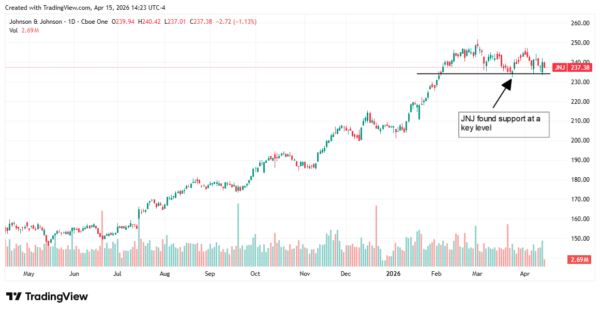
Heading into earnings, Johnson & Johnson was trading around $235, maintaining its broader uptrend while holding above key moving averages, signaling steady institutional support.
Following the release, the stock saw an initial push toward the $244–$246 range, but failed to sustain that breakout, quickly pulling back and testing support near $235. Importantly, that level held, with price rebounding and stabilizing around $238–$240, indicating buyers stepped in on weakness.
Momentum reflects a reset rather than deterioration. RSI held around 51.18 at earnings, suggesting the stock had room to move but lacked strong directional conviction. Volume showed spikes on both the selloff and rebound—pointing to active participation rather than distribution.
Taken together, the reaction indicates expectations were largely priced in. The failed breakout caps upside in the short term, but holding above support reinforces a stock under pressure yet still supported.
From Patent Powerhouse to Execution Story
What looks like steady, reliable Johnson & Johnson growth on the surface is, in reality, a transition playing out in slow motion. A case of legacy dominance anchored by a single blockbuster, to distributed execution across a portfolio where several assets must perform in concert to hold the story together.
So far, the transition is working. But the margin for error has narrowed, and the execution requirement has increased. This is no longer a story of inherited stability built on patent-protected dominance. It is one of sustained competitive performance, maintained quarter by quarter, in one of the most contested spaces in global healthcare.
For now, Johnson & Johnson is a buy as it’s performing well enough to keep the narrative intact.



Tidak ada komentar:
Posting Komentar