Hey there! You're reading The Budget Analyst — a calm space in the noise of markets.
Here we collect signals, patterns, and quiet insights that help you see the bigger picture.
No rush, no hype — just clarity for your financial journey. | | | | In partnership with Brownstone Research, RAD INTEL, Base Camp Trading. |
|
|
|
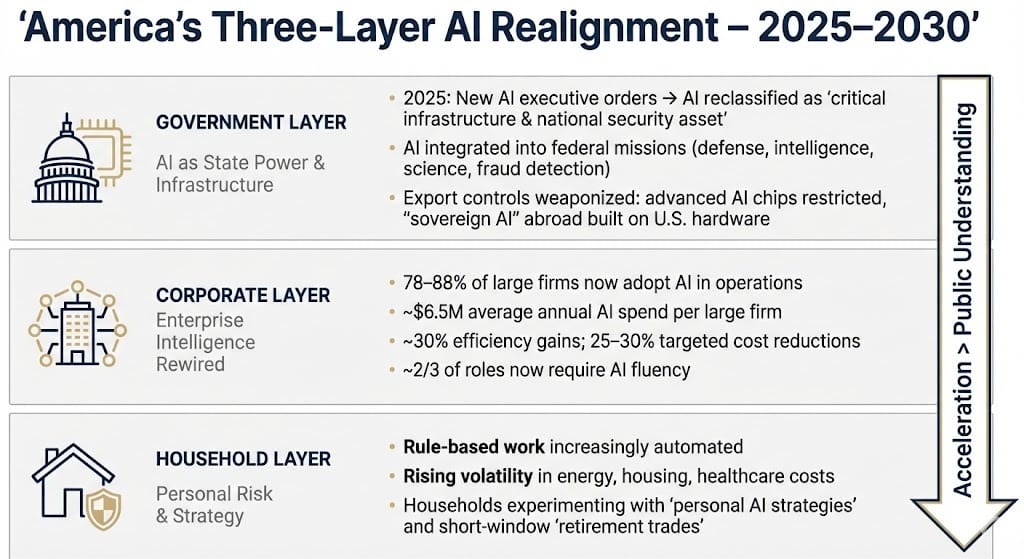
| | | | | The first thing you notice is the silence. | Not in markets—they're loud as ever—but in the way institutions move. Budgets reallocated without press releases. Data-center sites bought in rural counties no one can place on a map. Executive orders drafted in dense legalese that, read closely, quietly redefine what "infrastructure" means in the United States. | Beneath that silence, something decisive is happening. | America is entering a three-layer AI realignment—government, corporate, and household—and each layer is accelerating faster than most people understand. The result is not a tech story. It is a structural shift in who holds power, how wealth compounds, and what risk actually looks like from now to 2030. | |
| |
| | |
| | | | | The Federal Pivot | In 2025, Washington stopped treating AI as a regulatory problem and began treating it as an asset class of national power. | The Trump administration's new AI orders reframed artificial intelligence as critical infrastructure and national security architecture—placing it in the same conceptual bucket as aircraft carriers, GPS, and satellite constellations. AI was no longer just something to "encourage" or "manage." It became something the state must build, weaponize, and defend. | Deregulation followed. Older, cautious frameworks around model deployment, data-sharing, and procurement were stripped back or rewritten to "remove barriers" to American AI leadership. Agencies were told not only to explore AI, but to integrate it into their core missions: intelligence analysis, border security, scientific research, entitlement fraud detection, and battlefield planning. | At the same time, export controls tightened. Cutting-edge chips and tools became components of foreign policy, with access governed by national-security criteria rather than pure trade logic. Allies were offered "sovereign AI" partnerships built, in practice, on U.S. hardware. Rivals found themselves fenced out. | The message from the federal layer is unambiguous: AI is now part of statecraft. The U.S. government intends to own as much of the strategic high ground as possible, even if that means bending traditional notions of markets, competition, and neutrality. | AI as Infrastructure | Once AI is framed as power, the next question is physical: where does all this intelligence actually run? | The answer, right now, is in concrete and copper. OpenAI's "Stargate" project—a single, multi‑year buildout of next‑generation data centers and power—has been framed with a headline number in the $500 billion range. It is one initiative in a broader wave of mega‑capex AI infrastructure: hyperscale campuses, cooling systems, fiber, grid interconnects, and the engineering talent to run them. | | Large language models are not weightless. They are electricity and land and steel. Every new training run is a line item on the global energy ledger. As models scale, the pressure on grids escalates: more baseload demand, more volatility, more need for firm supply. | That is why AI infrastructure is increasingly discussed in the same breath as the power system. Rural counties with transmission access are being scouted as future compute hubs. Old industrial regions—places that once processed coal or aluminum—are being quietly repurposed as locations for AI campuses. | Financing is evolving too. Public–private partnerships, long used for toll roads and bridges, are now being explored for AI infrastructure. Municipalities provide land, tax treatment, and grid connections; private consortia provide capital and technical design. For local governments, AI data centers become 30‑year anchor tenants. For federal planners, they become strategic assets embedded throughout the country. | AI is no longer just a stack of models. It is a built environment. | Nvidia as De-Facto State Partner | At the center of this buildout sits a single company that has drifted from "vendor" toward "partner in national capacity." | The Department of Energy's new Solstice and Equinox supercomputers—slated to be among the most powerful AI systems ever deployed—are designed around roughly 110,000 Blackwell‑generation GPUs, stitched together to deliver around 2,200 exaflops of AI performance. The systems are joint efforts: federal agencies, national labs, cloud providers, and Nvidia acting in concert. | It is a public–private model, but the dependency is clear. The U.S. state wants cutting‑edge AI for science, defense, and energy; Nvidia supplies the silicon, the networking stack, the software layer that makes it all usable. Sovereign AI projects abroad, marketed as independent, still often rely on that same hardware and tooling under the hood. | In effect, Nvidia has become part of the country's AI plumbing. When federal strategy documents talk about "national AI capacity," a nontrivial slice of what they mean sits on Nvidia boards, in Nvidia chassis, speaking Nvidia software dialects. | That is where a new kind of briefing enters the picture—one that spells out just how deep this integration runs, and what it means for investors who missed the first leg of the AI chip boom: | | Thanks to this new deal, this AI model will now be deployed across the U.S. government. | According to NVIDIA's CEO, this is all part of a revolution that could create $100 trillion in total value… Which is worth almost 25 NVIDIAs. | So if you missed out on the massive gains from NVIDIA during this AI boom… | | Treat it less as a pitch and more as a signal. When the same architectures that price ad impressions are also running climate simulations, nuclear research, and defense analytics, the line between "market tech" and "state tech" has blurred. That has consequences for resilience, regulation, and how concentrated risk has become. |
| |
| | |
| | | | | The Corporate Intelligence Shift | While Washington builds AI into state capacity, corporate America has made its own pivot. | By 2025, surveys show roughly 78–88 percent of large enterprises now use AI in at least one core function. Typical annual AI spend among big firms hovers around $6.5 million, concentrated in a few key areas: process automation, forecasting and planning, risk scoring, customer analytics, and decision support. | The headline is not that companies use AI. It's how quickly they've woven it into operating muscle. | Firms report efficiency gains on the order of 30 percent in AI‑enabled workflows, alongside 25–30 percent cost reductions in targeted areas like customer support, invoice handling, and predictive maintenance. Over time, those small deltas compound into structurally higher margins for early adopters, and shrinking room for those who lag. | This has a labor dimension. Roughly two‑thirds of roles in many sectors now list some form of AI fluency as a requirement or expectation. Not as "nice to have," but as baseline. That creates a quiet sorting mechanism: workers who can orchestrate AI systems rise faster, while those who can't find their roles gradually narrowed, then automated. | Corporate intelligence is no longer strictly human. It is hybrid—and the edge lies with organizations that can marry AI scale with human judgment. | Marketing as the Early Proof | If you want to see that hybrid intelligence at work, look at marketing. | In 2025, AI marketing spend is estimated around $47 billion, with projections north of $100 billion by 2028. In practical terms, that means most serious marketing operations are now AI‑saturated: between 88 and 93 percent of marketers report daily use of AI tools to segment audiences, personalize creative, run experiments, and optimize spend. | The results show up fast. Campaigns that used to take weeks are deployed in hours. A/B tests run at machine speed. Revenue uplift from tighter targeting and real‑time optimization becomes visible in quarterly numbers. | That's why some of the most sophisticated investors have started watching AI marketing platforms as early indicators of where corporate intelligence is heading. | Which is where one of the more striking "intelligence layer" briefings comes in: | The companies that power intelligent content will dominate the next decade. | And one of the biggest potential winners? | RAD Intel — the AI marketing intelligence platform quietly rising in valuation (from $4M to $200M). | Brands such as Hasbro, Skechers, MGM, Omnicom, Adobe, and Sweetgreen already use RAD Intel to eliminate wasted ad spend and generate measurable ROI (per SEC filings) using AI that predicts campaign performance before money is spent. | This isn't a theory. | This is 90 billion+ data points, 125,000 AI personas, 600+ API connections, and proprietary AI scoring powering Fortune 1000 growth. | And their share price? | Still just $0.85. | With Adobe as an investor, Fortune 1000 contracts growing, and a Nasdaq ticker reserved as $RADI — RAD Intel is closer than ever to a potential future public listing (if approved). | Over 10,000 investors already participated. | You still have a chance before the current round fills. | | Strip away the pitch surface, and you see the deeper pattern: marketing is where AI first learns to map human behavior at scale, then monetize it. That capability does not stay confined to ads. | RAD Intel as Macro Case Study | Think of RAD‑style systems as a prototype of the emerging meta‑layer: AI that sits above everything else. | This "intelligence layer" ingests public filings, satellite imagery, supply‑chain data, credit‑card flows, social sentiment, clickstreams, and macro indicators. It doesn't just report history. It models behavior in real time: how likely a given cohort is to buy, move, vote, cancel, default, or churn. | At scale, that has three macro implications. | First, it compresses reaction time. When AI can detect a shift in consumer behavior or geopolitical risk in hours instead of quarters, capital moves faster. Markets gap, rather than drift. | Second, it narrows information asymmetry for those plugged into the layer—and widens it for those who are not. The gap between households with generic news and institutions with live behavioral maps grows. | Third, it creates feedback loops. If enough capital responds to the same signals, AI‑driven expectations can become self‑fulfilling in the short term, amplifying volatility. | RAD‑type systems are not just "tools." They're early versions of the infrastructure that will sit between reality and how markets perceive it. |
| |
| | |
| | | | | Household Compression | Against this backdrop, the American middle class is being squeezed from three directions at once. | On the income side, AI is automating precisely the kind of rule‑based, mid‑skill work that powered post‑war stability: back‑office processing, routine analysis, basic coding, standard legal and accounting tasks. Workers whose value was their ability to follow complex procedures now compete with systems that can replicate those procedures at near-zero marginal cost. | On the expense side, volatility in energy, housing, and healthcare is rising. Energy demand from AI data centers adds pressure to already strained grids. Housing affordability remains chronic in key regions. Healthcare costs move with policy shocks and demographic strain rather than wage growth. | The result is wage bifurcation: workers whose roles are complemented by AI—those who design systems, direct strategy, manage complexity—see their earning power rise. Those whose roles are substituted by AI see flat or fragile income, just as their cost base grows more unstable. | The old middle‑class formula—steady job, rising home equity, diversified retirement account—was built for a slower, more predictable macro regime. That regime is fading. | Rise of Personal AI Strategies | In response, something new is emerging at the household level: deliberate, "personal AI strategies." | At a basic level, people are using AI to scan job postings, understand automation risk, and re‑skill. But the more sophisticated use cases are financial. Individuals are feeding their bank transactions, retirement accounts, mortgage, local labor data, and even energy bills into AI tools, asking: | How exposed is my job to automation? How correlated is my portfolio to a handful of AI megacaps or rate-sensitive sectors? What happens to my solvency if rates, rents, or premiums move by specific increments?
| Done well, this is not day‑trading. It is risk mapping—using the same kind of intelligence layer that corporations deploy, but aimed at a single life. | The households that adopt this mindset early gain something intangible but critical: lead time. They see the wave coming a little sooner. | | The Retirement Trade Phenomenon | Inevitably, this re-mapping of risk shows up in how people think about retirement. | Traditional advice—set-and-forget index funds, dollar-cost averaging, hope the 60/40 portfolio holds—was built for a world where macro regimes shifted over decades. An AI‑accelerated environment, with faster policy swings and more reflexive markets, makes that assumption weaker. | That is why a new species of "retirement trade" narrative is circulating: short, repeated windows for income and risk control in a high‑feedback market. | I've seen a lot of "passive income" promises in my time. | Buy and hold. Buy more. Sit tight. Pray the market goes up. | This? | This isn't that. | What I saw was a short, repeatable trading window that shows up 3 to 5 times a week, between 9:30 and 10:45AM. | ✅ No late nights. | ✅ No wild swings. | ✅ No waiting years to maybe break even. | Just one move — in and out. | Before your coffee's even cold. | You don't need a huge account. | You don't need 10 monitors. | You need a few minutes, a plan, and the guts to take control of your time. | They call it The Retirement Trade. | I call it the best-kept secret on the street. | Get the free strategy guide — and see it for yourself. | | Beneath the copy, there is a real structural point: in a regime where macro conditions and market microstructure change quickly, the old promise of "time in the market" feels less comforting. People are groping for ways to synchronize income generation with shorter, more knowable windows. | Whether any given method works is a separate question. The phenomenon itself—households abandoning slow certainties for faster, more tactical approaches—is a sign of how deep the perception of instability has become. | The Years Ahead | America's three-layer AI realignment is not waiting for public consensus. It is underway. | Government is embedding AI into hard power and infrastructure. Corporations are rewiring their operating brains around hybrid human–machine intelligence. Households, in fits and starts, are beginning to use AI to understand and defend their own positions in this new terrain. | The acceleration is uneven. Policies will misfire. Some infrastructure bets will fail. Many households will overreact or underreact. But the direction is clear: intelligence at scale is becoming the organizing principle of power and wealth. | By the time this is widely acknowledged—not as tech optimism or anxiety, but as simple macro reality—the main structures will already be built: the data centers, the contracts, the workflows, the playbooks. The question, for anyone living through this shift, is not whether AI will realign government, corporations, and households. | It is whether they will notice that realignment while they still have room to move. |
| |
| | |
| | |
|




Tidak ada komentar:
Posting Komentar