| | Good Tuesday — here's what actually matters today. | The boundaries of the economy are expanding—literally. While Google looks to low-earth orbit to solve the AI energy crisis, central banks and sovereign states are racing to secure hard assets (Gold & Bitcoin) on the ground. The "Energy Wall" and the "Monetary Reset" are no longer theories; they are funded line-items on the world's biggest balance sheets. |
|
| 🛰️ Google Confirms "Project Suncatcher" for 2027 Launch | | The "AI Energy Wall" has forced Big Tech off-planet. CEO Sundar Pichai has officially confirmed Google will launch "Project Suncatcher" in early 2027. This initiative aims to test AI data centers in orbit, leveraging solar energy that Pichai claims is "100 trillion times" more abundant in space than on Earth. This is not a stunt; it is a desperate pivot. With terrestrial grids failing to meet the gigawatt-scale demands of training runs, Google is seeking to offload heavy compute to space where solar efficiency is constant and heat rejection is easier. While the pilot begins with two satellites, the roadmap calls for "city-sized" orbital clusters by the 2030s. |
|
| | | | (Sponsored by Brownstone Research) | Google's shocking announcement changed everything. | | Sundar Pichai just admitted AI is chewing through Earth's power… and Google is now planning data centers in space. | When trillion-dollar tech runs out of outlets, regular investors get one tiny window. | Jeff Brown says the real money isn't in rockets. | It's in the new "AI Fuel" powering Trump's fast-tracked Freedom Factories here at home. | This is your shot. | Click here before the crowd wakes up. | |
| |
| | |
| | 🥇 Gold Breaks $4,200: JPM Sees $5,000 Next | | Gold has entered a new valuation paradigm. Spot gold consolidated above $4,208/oz this week, driven by an unceasing "Central Bank Put." Sovereign accumulation has averaged a stunning 710 tonnes per quarter in 2025, with China's PBoC marking its 13th consecutive month of reserve expansion. Institutional heavyweights are chasing the trend. JP Morgan has aggressively hiked its price target, now projecting gold to average $5,055/oz by Q4 2026. This is a structural repricing of the global reserve layer as capital rotates into hard assets to hedge against stagflation. |
|
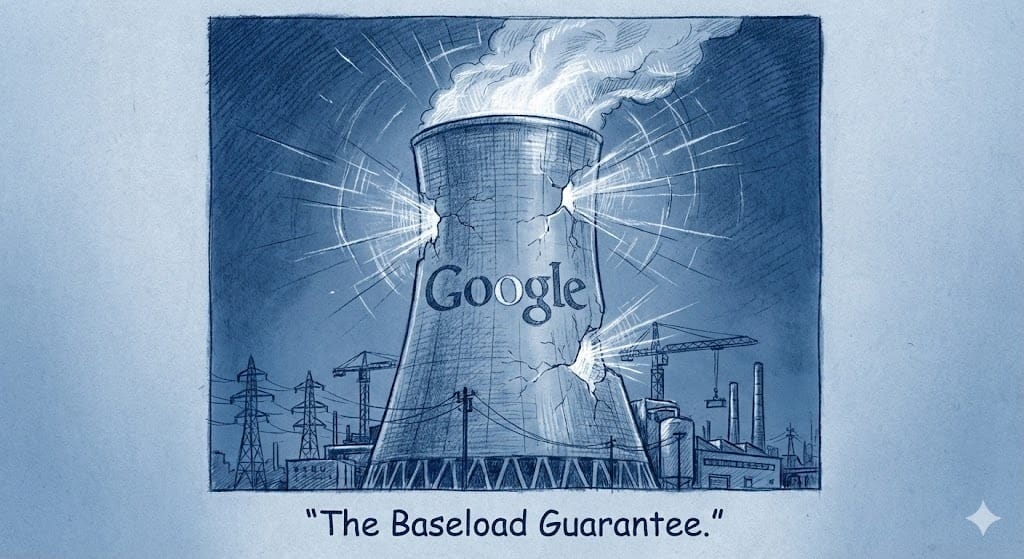
| | | | ☢️ Uranium Deficit: Google Restarts the Nuclear Age | | Tech giants are effectively functioning as nation-states, directly funding nuclear infrastructure because the public grid cannot guarantee the "always-on" power required for AGI. Google and NextEra Energy have signed a definitive deal to restart the 600 MW Duane Arnold nuclear plant in Iowa by 2029. This comes as the uranium market faces a structural supply deficit of ~30 million pounds in 2025, projected to widen to 60 million pounds by 2030. Utilities are now forced to sign long-term contracts at premium prices to secure fuel. |
|
| | 💳 Consumer Credit: The $1.2 Trillion On-Chain Pivot | | Real World Assets (RWAs) are graduating from "safe" government debt to "high-yield" consumer credit. The U.S. credit card receivables market sits at approximately $1.13 trillion, with consumers earning over $41 billion annually in rewards value. This massive asset class is moving on-chain. New data shows 25% of transaction volume is projected to move to tokenized rails by 2027 to slash fees and fraud. While tokenized private credit has hit $14 billion, the "Holy Grail" is consumer debt—offering double-digit yields that dwarf the 4-5% available in tokenized Treasury bills. |
|
| | | | (Sponsored by Amara) | Everyone's chasing Treasury RWAs. Meanwhile, the real sleeping giant is hiding in plain sight: $1.2T in U.S. credit-card receivables and $500B+ in rewards value moving every year. | AMARA is turning that flow into a tokenized yield engine, and now you can invest. | Card spend → receivables → interest → buyback + burn of EMBR (AMARA's rewards-backed asset). | | Real economic activity → real token demand. | RWAs are the hottest theme in crypto right now, and nobody is looking at the consumer side. | This is the one they'll say was "obvious" later. | Own the next consumer-scale RWA engine | Disclaimer: This is a paid advertisement for AMARA Reward's Regulation CF offering. Please read the offering circular at http://invest.amararewards.com/. |
| |
| | |
| | 🇺🇸 The Strategic Reserve: Texas Buys Bitcoin | | Bitcoin has completed its transition from "speculative asset" to "strategic reserve." The State of Texas officially purchased $5 million in Bitcoin this month, becoming the first state to execute on a "Strategic Bitcoin Reserve" mandate. This follows the federal "BITCOIN Act of 2025" proposal and signals that sovereign entities are no longer banning digital assets—they are racing to accumulate them before the supply shock hits. |
|
| | 🧭 What This Means | For Tech: Energy > Compute. Google going to space and restarting nuclear plants proves that power availability is the only metric that matters for AI scaling. For Macro: The "Central Bank Put" is real. 710 tonnes of gold buying per quarter is a defensive wall against currency debasement. $5,000 gold is now the base case. For DeFi: The yield chase is on. As Treasury yields compress, crypto capital will aggressively rotate into Consumer RWAs (credit card debt) to find double-digit returns..
|
|
| | 🔍 Insight | The theme of 2026 is "Sovereign FOMO." Tech companies are securing sovereign energy (Nuclear/Space). Central Banks are securing sovereign money (Gold). States (Texas) are securing sovereign code (Bitcoin). The entities with the most to lose are no longer sitting on the sidelines—they are buying the scarce assets that underpin the future. |
|
| | POLL — Which "Sovereign Asset" performs best in 2026? | |
|
| |
|




Tidak ada komentar:
Posting Komentar