Day traders often think that there's one tool or indicator that will generate their 'aha' moment and send them on the path of profitability.
But that's not the case…
Trading is about having a full toolbox of tools you put together with your knowledge to start finding consistency.
Think about it this way…
Anyone can have a toolbox with a hammer, drill, level, and square, but they need the knowledge before they can use the tools to build a house or even a shed.
It's the same with trading.
You can have a broker and a platform and all the indicators in the world… But without knowledge of how to use them, they're useless.
So how do you use it? When should you use it? And what are the downfalls?
Read on to find out…
How to Use Level 2
Level 2 is a box on your platform that shows you buyers and sellers and what price they're willing to pay…
It's a list of orders waiting to get filled. And it can help you spot whether a stock is bullish or bearish…
If Level 2 shows a lot of orders stocked in the bid column, with prices close to the current bid, that can be a bullish sign. Buyers are lined up to buy the stock.
But if the Level 2 box shows a wall of sellers stacked on the ask column, those sellers can act as resistance and keep the stock from going higher.
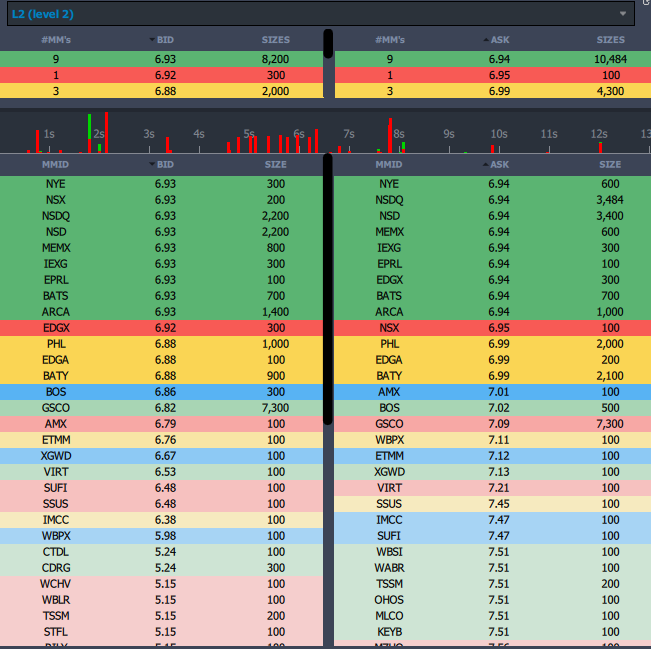
Look at this Level 2 example from Melco Resorts & Entertainment Limited (NASDAQ: MLCO). It was just one of Oracle's winning picks yesterday…
During midday trading, you can see there are an equal number of buyers willing to pay $6.93, as there are sellers willing to sell for $6.94.
But you can see the size on the ask is higher than the size of the buyers. That means sellers are selling more shares than buyers are wanting to buy.
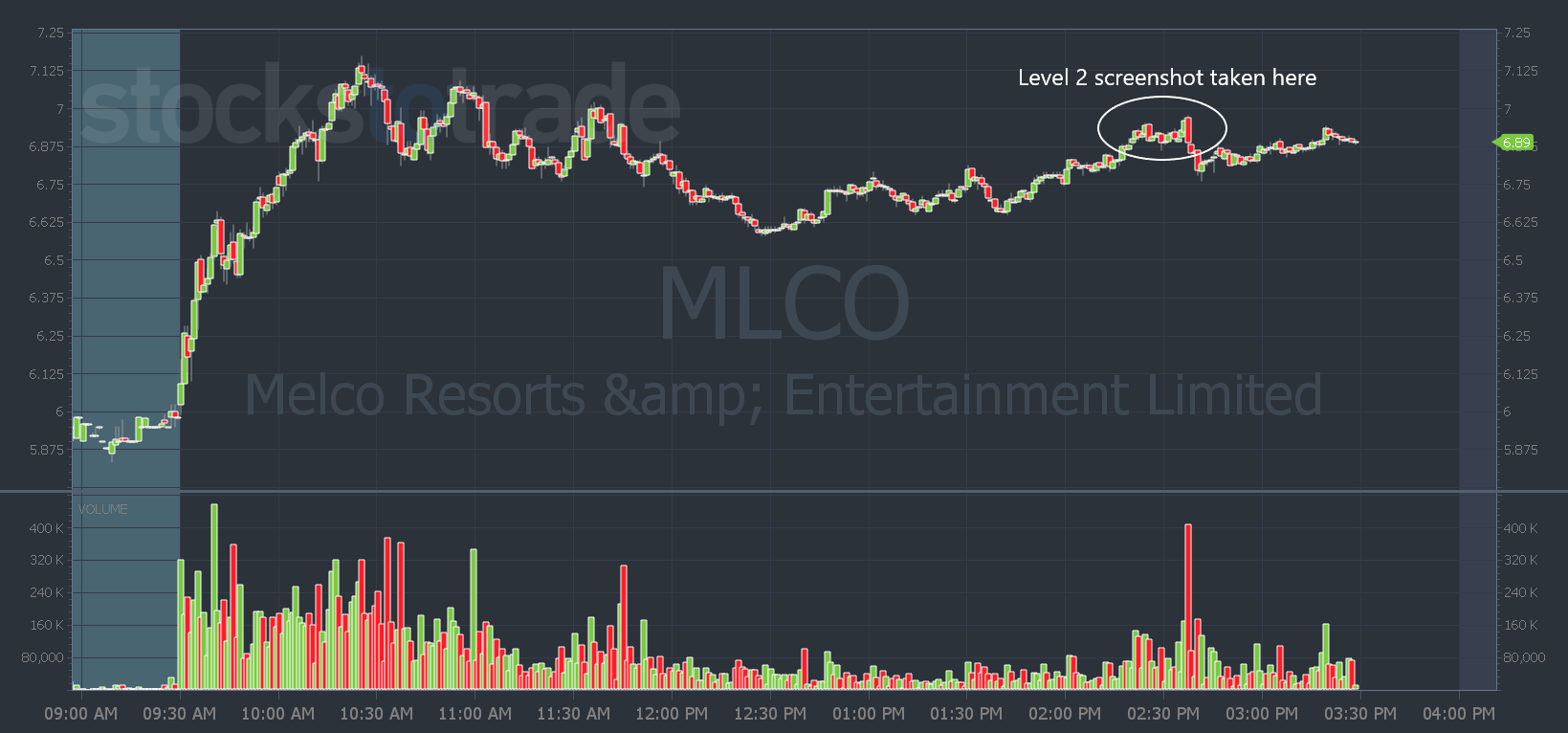
This was taken yesterday afternoon when the stock was trying to get back to the high of day.
But you can see it on the chart it rejected and went lower…
And when it comes to liquid Nasdaq stocks, there are so many games traders and market makers can play...
Orders can appear and disappear. Traders can hide their orders. And traders can cancel orders before they're filled.
That's why I mostly look at Level 2 when I'm in a trade…
Before I enter a trade, I'm focused on the pattern, key levels, VWAP, and price action.
But once a pattern has played out and I'm in the trade, then I care more about Level 2.
I care where big buyers and sellers are...
And I want to see if someone keeps dumping shares at a certain price and preventing it from climbing higher.
How to Use Level 2
If you see a big seller on the ask side of the Level 2 box, it might be time to get out.
But you also have to read the price action…
If you don't see big sellers on Level 2 but the stock is struggling to go higher, someone could be dumping shares with a hidden order.
You can also use Level 2 to help you pick levels to set your stop.
If there's a big bidder showing on Level 2 after you're in a position, you can risk just below that buyer.
Because if that big order fills, that means someone is hitting the bid and selling to get out. Or if it disappears, that can mean demand for the stock is gone.
And if there aren't many bidders below that, the stock will likely go lower.
Level 2 can seem complicated to new traders. If you want to learn more about it — check out this video.
Every market-open, this proprietary scanner (with an 85% win-rate on the year) filters through thousands of stocks within seconds to create a list of 20 potentially big-movers.
Imagine the hours of research this powerful algorithm can save you every morning.
Your next big trade could be alerted to you by this scanner as early as pre-market tomorrow…
(As an Amazon Associate, we earn from qualifying purchases.)
13809 Research Boulevard, Suite 500, Austin, TX 78750
*Please note that these kinds of trading results are not typical. Most traders lose money. It takes years of dedication, hard work, and discipline to learn how to trade, and individual results will vary. Trading is inherently risky. Before making any trades, remember to do your due diligence and never risk more than you can afford to lose.
This is for informational purposes only as StocksToTrade is not registered as a securities broker-dealer or an investment adviser. No information herein is intended as securities brokerage, investment, tax, accounting or legal advice, as an offer or solicitation of an offer to sell or buy, or as an endorsement, recommendation or sponsorship of any company, security or fund.
StocksToTrade cannot and does not assess, verify or guarantee the adequacy, accuracy or completeness of any information, the suitability or profitability of any particular investment, or the potential value of any investment or informational source. The reader bears responsibility for his/her own investment research and decisions, should seek the advice of a qualified securities professional before making any investment, and investigate and fully understand any and all risks before investing.
StocksToTrade in no way warrants the solvency, financial condition, or investment advisability of any of the securities mentioned in communications or websites. In addition, StocksToTrade accepts no liability whatsoever for any direct or consequential loss arising from any use of this information. This information is not intended to be used as the sole basis of any investment decision, should it be construed as advice designed to meet the investment needs of any particular investor. Past performance is not necessarily indicative of future returns.








Tidak ada komentar:
Posting Komentar