Should You Invest in the GE Breakup Dear Reader,
I’ve been telling you about my colleague’s stock picking/market forecasting system.
First, I told you about how he and a team of quants came up the “VQ number.” That’s the measure of volatility – or risk – in a stock or other security.
That measurement is focused on the moves a security makes – and it alone tells you: - When to buy a security.
- When to sell a security.
- And how risky that security is – how much movement you should expect.
Then, I showed you how my colleague’s system can help you avoid making one of the biggest mistakes almost all investors make: buying too much or too little of a stock. It does so with its “Position Size Calculator.”
My colleague is going to reveal a whole lot more about his system during Market Shock 2022. You’ve already secured your place for that event that starts at 4 p.m. on Thursday, Sept. 29. – and can still lock in VIP stats here. We’ll send you a reminder email right before we get started, but I also encourage you to mark that date and time down in your calendar.
Before we get to that big event, I want to share one more short report with you.
You see… the first few times we talked, I used an example from my colleague’s past – his buy and quick sell of Advanced Micro Devices Inc. (AMD) – to demonstrate the effectiveness of his VQ system. I also showed you how this “early warning” system could have alerted you to historic moves in the market – the dot-com crash in December of 1999… and the financial collapse of 2008 – before they happened.
And that may make you wonder whether his system can be used for “current events.”
I’ll use this report to answer that question…
When a company plans a spinoff, it can make big news in the mainstream media.
Consider the breakup of Ma Bell back in the 1980s.
But smart investors know that spinoffs are more than news. These “special situations” can lead us to big profits.
Deloitte and Edge Consulting Group found that between 2000 and 2014, spinoff stocks generated a 22% return in the first 12 months of trading. That’s even better than the 14% return of the parent company that performed the spinoff.
Will the same happen when General Electric Co. (GE) splits itself up? My colleague recently put his system’s radar on it.
But before we get to that, let’s first remember how GE got to this point… Dismantling a Giant In its heyday, the 1980s and 1990s, General Electric stock returned more than 25% a year, on average.
In fact, in September 1993, it was the most valuable publicly traded company.
But in the early 2000s, less-efficient business units and bad bets started to take their toll on the company — and on investor’s confidence. From 2000 to 2018, GE shares shed 7% a year.
The company also went from a $474 billion market cap in 2000 to a $71.6 billion market cap as I write this, shedding more than $400 billion in value in 22 years.
But that’s where GE has been.
But we’re more interested in where it’s headed, because that’s where profit opportunities can be found.
GE is spinning off into three distinct companies: - GE Aerospace
- GE HealthCare
- GE Vernova
 Source: GE Q2 2022 Presentation Source: GE Q2 2022 Presentation
The Aerospace division makes jet engines and integrated systems for military, commercial, and general aircraft operators.
With fewer flights and less traveling because of COVID-19, the Aerospace division has suffered a loss in sales. In 2021, GE’s aviation division generated $21.3 billion in sales, which was 35% less than the $32.8 billion it generated in 2019.
However, thanks to the recent growing demand for airline travel, aerospace companies’ financial results are expected to return to pre-pandemic levels by 2024.
Like the Aerospace division, GE’s HealthCare unit has suffered a loss in sales since COVID-19. With people only visiting hospitals for emergencies and using more telemedicine options, hospitals had less of a need for some of GE’s products.
Sales in 2021 for the HealthCare unit were $17.7 billion, down 11% from $19.9 billion in 2019.
But once GE HealthCare is spun off, being more focused would allow it to make more strategic acquisitions, boosting revenue. Instead of trying to organically create growth, GE HealthCare executives can go out and buy growth.
The final company from the spinoff will be GE Vernova, whose name is a combination of the Spanish verde for “green” and the Latin novus for “new.”
The company has a portfolio of energy operations including onshore and offshore wind turbines, electrical distribution grids, hydropower, and the storage of renewable energy.
GE CEO H. Lawrence Culp Jr. says that wind energy is still “an immature industry,” with wind turbine makers GE, Vestas Wind Systems, and Siemens Gamesa Renewable Energy losing a combined $2.4 billion in the past 12 months.
With all three businesses running on their own, and considering debt, other liabilities, and assets, projections suggest the market cap of all three companies combined could be between $130 billion and $140 billion. What the VQ System Says About GE Former GE CEO Jack Welch once said, “Change, before you have to.”
GE hasn’t followed that advice over the past couple of decades. However, the change that comes through the spinoff could allow the company to bring new profit opportunities to investors.
Of course, instead of taking everything at face value, my colleague ran GE through his trading algorithms to see if his system says now is the time to make a move.
While the company appears in the portfolio holdings of several high-profile billionaire investors, the Volatility Quotient system that my colleague is going to tell you a lot more about Thursday afternoon says now is not the time to buy.
Here’s what my colleague tells me after analyzing the company: GE entered the Red Zone on April 29, and it’s considered high-risk, with a VQ of 34.57%.
So, the snapshot of the situation is that there is value that can be unlocked from this spinoff, but now is not the time to make a move. In the meantime, another corporate spinoff is currently in the system’s Green Zone. You can learn how to get all the insights on how to make an informed investing decision on that spinoff by attending my colleague’s Market Shock 2022 event on Thursday, Sept. 29, at 4 p.m. Eastern.
You’ll also learn how this system recently alerted investors to take their money off the table and sit out the coronavirus carnage of 2020.
Then, on March 27, 2020, it alerted my colleague and his system’s followers that a new bull market was forming and it was time to get back into the markets. 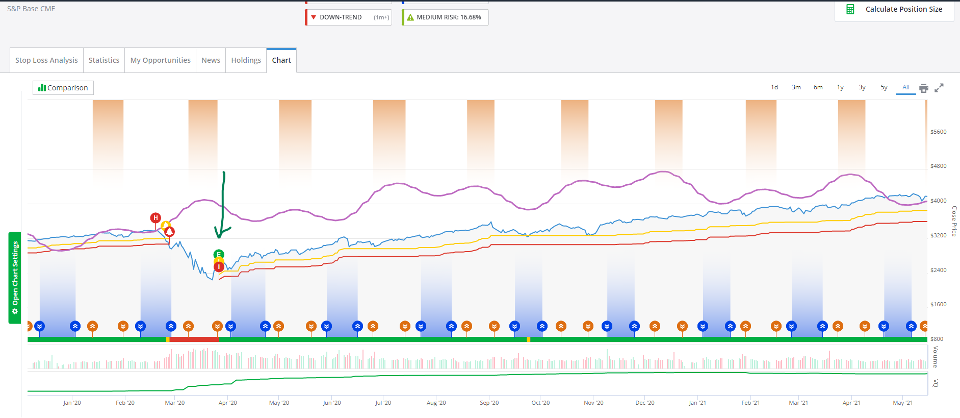
And boy are they glad they did…
Because stocks went on to produce a record breaking rebound.
Every time the markets have made a major move up or down for the past 20 years, you could’ve been alerted ahead of time and sidestepped every downturn and got back in at the perfect time with this system.
This system could issue a new alert at any moment.
And we’re giving InvestorPlace readers an unprecedented FIRST LOOK at this system… before its next alert goes out… during the special Market Shock 2022 event on Thursday, Sept. 29, at 4 p.m. Eastern.
I hope to see you there.
Regards, |





Tidak ada komentar:
Posting Komentar