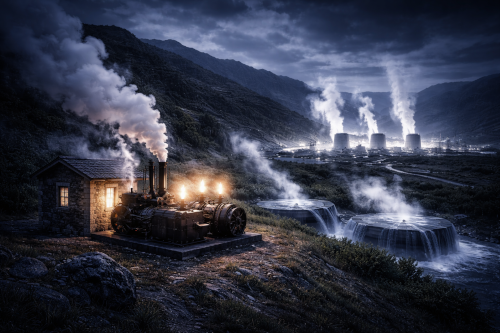
 Practical Investment Analysis for the New Energy EconomyThey Called It Devil's Valley, We Call It a Gold MineHave you ever heard of the four light bulbs that changed over in a little corner of Tuscany? Back in the summer of 1904, Tuscany locals had long called a small area there "Devil's Valley," after a prince named Piero Ginori Conti connected a small dynamo to a steam vent bubbling up from the earth beneath him. It lit four light bulbs... just four. The press barely noticed as the scientific community filed it away as a curiosity. Then for the next 54 years — until New Zealand built its first plant in 1958 — Italy was the only country on earth producing electricity from the ground beneath its feet. The rest of the world looked at geothermal and saw a novelty, nothing more than an anomaly that only worked in volcanic hotspots and nowhere else. They couldn't have been more wrong. Today, too many people are making the exact same mistake by quietly ignoring what's happening in the western United States. Why? Well, because the question was never whether the heat was there. Truth is, it always was — buried up to five miles beneath and cooking at temperatures that would melt steel. The real question has always been not whether we could reach it, it was whether we could tap into that energy source. Trust me, that question just got answered.
Trump Just Axed the IRS — $21,307 Windfall IncomingTrump just signed a historic order to replace the IRS with a $1 trillion fund that pays you. Everyday Americans could soon collect checks worth up to $21,307 — but only if they act before the first payouts hit. Devil's Valley — Everywhere Remember, all you need for traditional geothermal energy is just three things in the same place at the same time: heat near the surface, enough water, and a permeable rock that can circulate the fluid. Once you get all three — like they do in Iceland or California's Geysers — then build a plant. Miss any one of them and it's a no-go. So, you can understand why the U.S. has spent a century with its geothermal capacity clustered in just a few states out west, producing roughly four gigawatts — less than 1% of total electricity generation. You see, the geology was either right or it wasn't, and most of the country simply lost the geological lottery. Now, Enhanced Geothermal Systems (EGS) is about to abolish that lottery entirely. You see, what EGS does is take the horizontal drilling and hydraulic fracturing technology that our oil and gas industry has spent the last 30 years and hundreds of billions of dollars perfecting, and pointing it at a completely different target. Once they get around three miles deep into the hot, dry rock, they crack it and inject water down one well, let it heat against the rock — often past 300°F, sometimes past 500°F — and pull it back up through a second well as superheated fluid that drives turbines. The same techniques that unlocked the Permian Basin are now unlocking the heat beneath it. And the results are arriving faster than most people realize. Recently, the Department of Energy announced $171.5 million in new funding for next-generation geothermal field tests and exploration drilling nationwide. For the record, that's the single largest tranche of EGS funding in the history of the sector, with Letters of intent due next month. That's not a research grant, dear reader. What we're seeing is a clear deployment signal. In fact, Fervo Energy just drilled its hottest well to date at a greenfield site in Utah — hitting temperatures above 555°F at roughly 11,200 feet, all in under 11 days. Their flagship Cape Station project in Beaver County is fully permitted for up to two gigawatts, and is on track to begin delivering 100 megawatts of baseload power to the grid before year-end. Phase II adds another 400 megawatts by 2028. Again, that makes Cape Station the largest EGS project ever built. The DOE's own projections see geothermal capacity climbing to at least 300 gigawatts by 2050 — up from only 4 gigawatts today. To put a little context on this, that's enough to power the equivalent of every home currently powered by natural gas in America, running 24 hours a day, seven days a week, with nothing going into the atmosphere but steam. Makes sense, right? The geographic constraint that locked geothermal into seven states for a century just broke. How to Get a Six-Figure Payday From China's China's recent export ban on gallium, antimony, and germanium has sent shock waves through global markets, threatening to cripple U.S. national security. These critical metals are the backbone of America's defense infrastructure, essential for producing missiles, satellites, and fighter jets. Without them, the U.S. military is paralyzed. That's why the U.S. government is turning to a tiny American mining company to secure a reliable domestic supply of these vital materials. Drill, Baby, Drill… But Not For Oil For us, the key distinction here is that geothermal energy isn't in its discovery phase. It's being unlocked. You see, the heat was always there. Prince Conti knew it in 1904, the Los Alamos scientists knew it in 1974, but what nobody had — until now – was the technology to reach it consistently, repeatedly, and cheaply enough to matter. That technology exists today. The thing is, the market is still pricing this sector like it's 2015 — niche, speculative, geographically constrained, something for the back of the portfolio. However, institutional money is just beginning to move as corporate offtake agreements start stacking up… not to mention the fact that federal funding is just beginning to flow. Don't get me wrong, this isn't a story about overnight riches. Drilling is expensive, and permits take time. The learning curve is real, but here's what that learning curve looks like in practice: Fervo's most recent wells are drilling faster and cheaper than the ones before them. Of course, every successive well at Cape Station drives costs down — mirroring the exact trajectory that took shale from curiosity to industry in a decade. That's the part most people miss. And the winners in this era won't necessarily be the biggest companies or the ones sitting on the most acreage. They'll be the ones with proprietary drilling technology, proven subsurface data, real offtake agreements, and the operational discipline to drive that cost curve down well after well after well. You can't help but wonder which energy stocks will keep showing up on Wall Street's radar as this buildout accelerates. It's a good thing we don't have to wonder anymore — I'll show you the biggest winners jockeying for position right here. A hundred years ago, Piero Ginori Conti lit four light bulbs and nobody paid attention. The smart money isn't making that mistake twice. Until next time,
Keith Kohl A true insider in the technology and energy markets, Keith's research has helped everyday investors capitalize from the rapid adoption of new technology trends and energy transitions. Keith connects with hundreds of thousands of readers as the Managing Editor of Energy & Capital, as well as the investment director of Angel Publishing's Energy Investor and Technology and Opportunity. For nearly two decades, Keith has been providing in-depth coverage of the hottest investment trends before they go mainstream — from the shale oil and gas boom in the United States to the red-hot EV revolution currently underway. Keith and his readers have banked hundreds of winning trades on the 5G rollout and on key advancements in robotics and AI technology. Keith's keen trading acumen and investment research also extend all the way into the complex biotech sector, where he and his readers take advantage of the newest and most groundbreaking medical therapies being developed by nearly 1,000 biotech companies. His network includes hundreds of experts, from M.D.s and Ph.D.s to lab scientists grinding out the latest medical technology and treatments. You can join his vast investment community and target the most profitable biotech stocks in Keith's Topline Trader advisory newsletter.
|

 Check us out on YouTube!


Tidak ada komentar:
Posting Komentar