February 16, 2026
These Rare Stocks Can Go Up in Down Markets
Dear Subscriber,
 |
| By Nilus Mattive |
If the recent market action has you worried, I understand.
But I also have a solution … one that I know works from decades of personal experience.
These are the type of investments that not only weather bad conditions quite well but can even go UP as everything else is falling sharply.
No, not inverse ETFs or anything else complicated like that.
I’m talking about some of the oldest, most boring stocks on the planet — dividend-paying firms from the consumer staple, healthcare and utility sectors.
Just listen to this excerpt from a study conducted by my old employer, Standard & Poor’s, right after the last big market collapse in 2020:
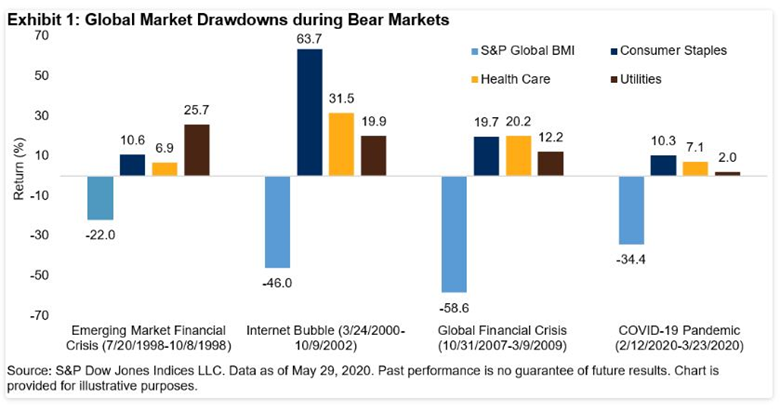
“Since Dec. 31, 1994, the global equity market has experienced four severe downturns when the S&P Global [Broad Market Index Total Return] declined 20% or more.
“However, three sectors — consumer staples, health care and utilities — stayed in positive territory during all the drawdowns.
“Exhibit 1 shows how these sectors performed during the four worst drawdown periods.
“While the broader market suffered an average 40% loss, the gains from consumer staples, health care and utilities sectors averaged 26%, 16% and 15%, respectively.”
Put simply, these groups of stocks can go up even when the markets are crashing.
And that’s for two main reasons …
#1. These types of businesses provide items people need, no matter what’s happening in the world or the economy.
That means they can keep on chugging along through thick and thin, generating solid cash flows and profits along the way.
#2. Because they produce consistent profits, they also tend to pay out steady (and often rising) dividends.
Those dividends provide ongoing income for shareholders, which further cushions any market downside and literally pays them to wait out larger downdrafts.
Plus, the defensive nature of the businesses and the dividends attract even more capital during market drops … supporting share prices further!
Of course, I don’t need academic research as proof. I’ve seen this play out firsthand plenty of times before.
For example, back in 2007, Dr. Martin Weiss and I launched a dividend service together.
My very first recommendations were the tobacco company Altria (MO) … the utility Consolidated Edison ( ED) … and the big pharmaceutical firm Pfizer ( PFE).
We not only held all three of them throughout the Financial Crisis, but we added more shares of each.
And we ended up with total returns ranging from 83.2% (one of the PFE positions) to a staggering 480.2% (one of the MO positions).
A good portion of those returns came from dividends. Which isn’t surprising.
In fact, dividends have accounted for roughly one-third of the stock market’s long-term returns.
And if you decide to reinvest the payments, their power is multiplied even further.
Consider this …
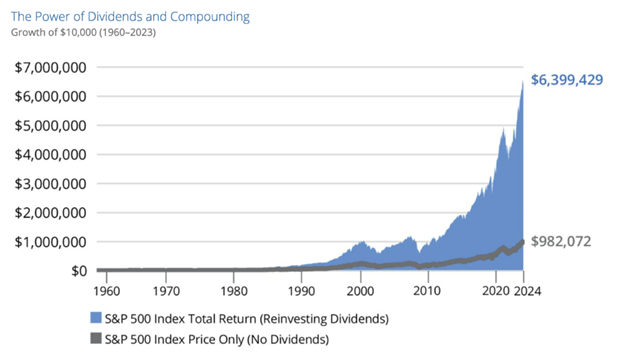
From 1960 to 2023, if you invested $10,000 in the S&P 500 but did not reinvest dividends, you’d have $982,072.
But if you did reinvest dividends, you’d have $6,399,429.
That’s six and a half times more money — all thanks to dividends.
This outperformance becomes even more dramatic when you look at individual stocks.
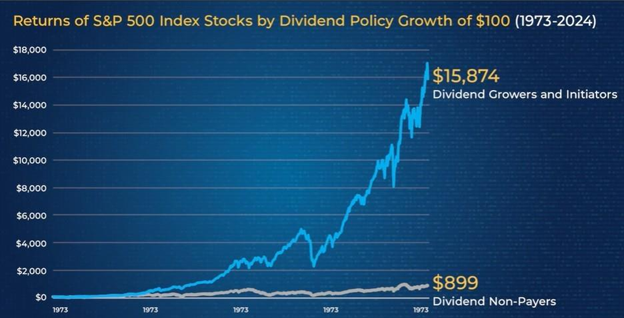
Consider this study from Ned Davis Research and Hartford funds from 1973 to 2024.
It found that over 50 years, companies that don’t pay dividends produced a total return of 799%.
What about companies that initiate and grow dividends?
They produced returns of 15,774%.
A return like that turns a $50,000 portfolio into almost $8 million.
This is why I have continued to favor dividend-paying stocks all the way up until today …
Why we have many of them in the Safe Money Report model portfolio …
And why I have just begun working on this brand-new project that is the most exciting way to play dividend stocks in Weiss Ratings’ history.
Don’t want to buy individual companies?
You can also get broad exposure to dividend stocks through various exchange-traded funds like the Vanguard Dividend Appreciation ETF (VIG).
Of course, Martin believes so much in our latest strategy that he’s now investing $500,000 of his own money into it.
And even if you decide not to start using it alongside him, that should at least encourage you to pay more attention to dividends from here on out.
Best wishes,
Nilus Mattive
P.S. We just sent out the first three dividend recommendations for that new project on Friday. So, you can still get into them right now.
Just watch this video and follow the instructions at the end.
But don’t wait … I’d like you to get in at the best prices possible.
Plus, we plan on issuing more recommendations later this week, too!



Tidak ada komentar:
Posting Komentar