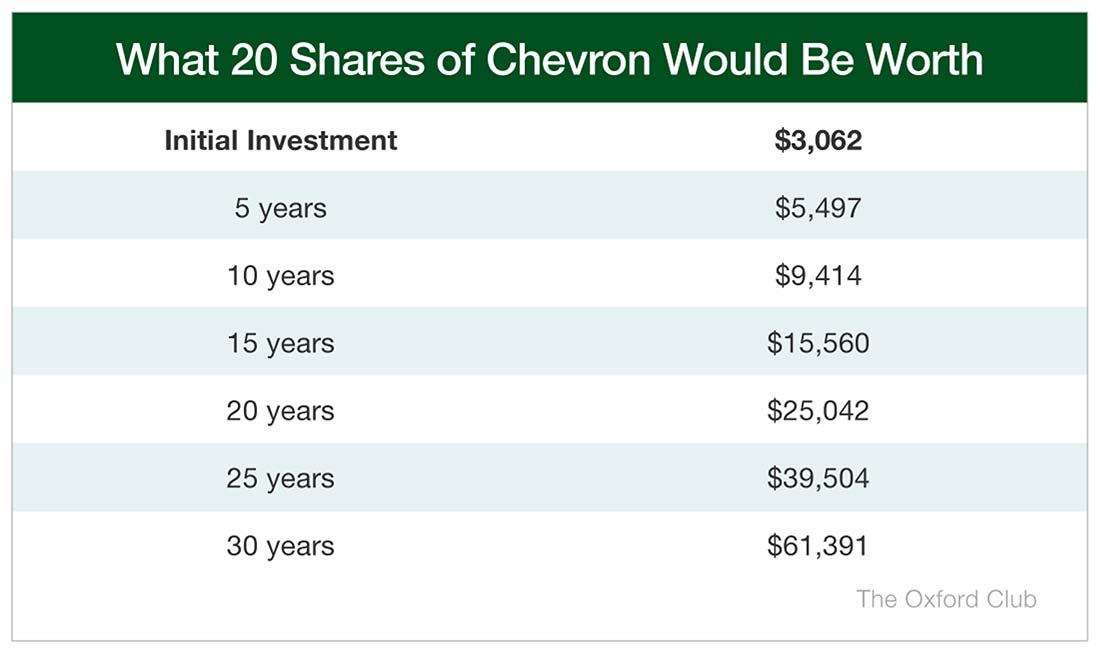
| For those of you who are unfamiliar with the concept, it goes like this: When a company pays dividends, you can collect the dividends in cash or automatically buy more shares of stock. For example, Chevron (NYSE: CVX) pays a $1.71 per share quarterly dividend for a yield of 4.5%. If you bought 20 shares at $153.11 (the price as I write this), you'd get paid $34.20 in dividends this quarter ($1.71 dividend per share x 20 shares = $34.20). If you reinvested the dividend, you'd automatically buy 0.22 more shares based on the same price ($34.20 in dividends / $153.11 share price = 0.22). Of course, the price could be higher or lower. If it were lower, you'd get even more shares, which would generate more dividends. The next quarter, if the dividend was the same, you'd get paid $34.58, which would automatically be used to buy more shares. That additional $0.38 seems like nothing, but if Chevron continued to raise the dividend at the pace it's done so over the last five years, your original $3,062 investment would grow by more than 80% over the next five years. By the way, that's if the stock simply kept pace with the historical average of the S&P 500. In other words, it wasn't a world-beater - just an average stock with a strong yield and terrific dividend growth. Here's what that original investment would be worth over various periods of time. You can see that after just 10 years, your investment would more than triple. After 30 years, you would've made more than 20 times your money - not by chasing the next home run, but by owning a "boring" dividend stock. Many of the readers on our trip invested according to this strategy, and it helped them afford a stay at Adare Manor, our last stop in Ireland (photo below). It was rated Condé Nast's top resort in the world. There is nothing boring about that. Good investing, Marc P.S. There's one key component of long-term income growth that most people don't think about. I consider it the single most important metric in predicting a stock's success. In fact, according to The Wall Street Journal, stocks with higher ratings in this metric consistently outperformed over a period of more than 30 years. Recently, for the first time ever, I filmed a video on how I use this calculation to weed out the underperformers and pick the stocks with the best chance of seeing long-term gains. I've got all the details for you right here. | 








Tidak ada komentar:
Posting Komentar