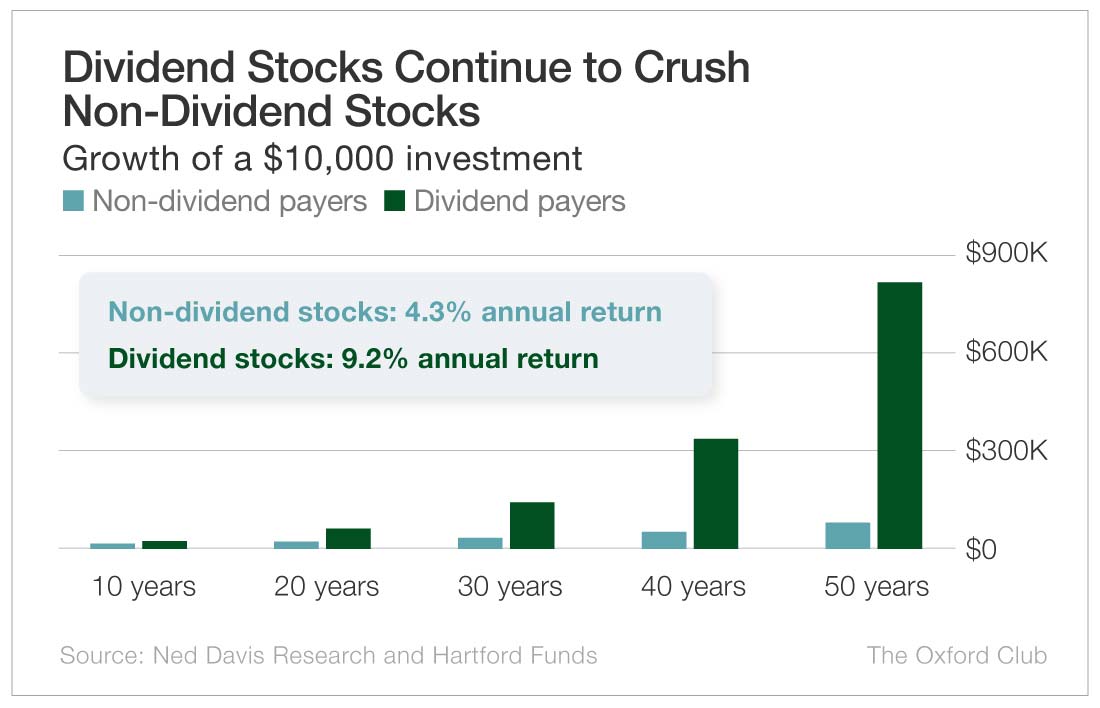
| Starting with $10,000, a 4.3% annual return over 10 years results in $15,235. An investor earning 9.2% ends up with $24,111. Expand that to 20 years, and we're talking the difference between $23,210 and $58,137. The dividend investor earned 150% more than the non-dividend investor. Three decades of investing results in $35,361 versus $140,177. Forty years means $53,873 for the nonpayers (still less than the dividend payers grew to in just 20 years) and $337,991 for the dividend payers. The gap widens each year. After 50 years, the dividend payers provide 10X the amount of money as the non-dividend payers. Dividend payers were 24% less volatile as well, allowing you to sleep better at night and perhaps helping you not bail out of your stocks when things get rocky. That will help your performance over the long term. All anyone can talk about right now is tech, tech, tech. But investing in a "boring" energy company like Chevron (NYSE: CVX), whose 4.6% dividend yield alone is already above the average annual return of the non-dividend payers, or a regional bank like Bank OZK (Nasdaq: OZK), with a 3.2% yield, gives you a much better chance of boosting your wealth than trying to pick the right tech stock. My friend's son is a finance major. He wants to work in private equity, financing exciting startups. But he's investing his own money where it has historically performed best. If you're not investing in dividend stocks, you are leaving a lot of money on the table. Good investing, Marc | 










Tidak ada komentar:
Posting Komentar