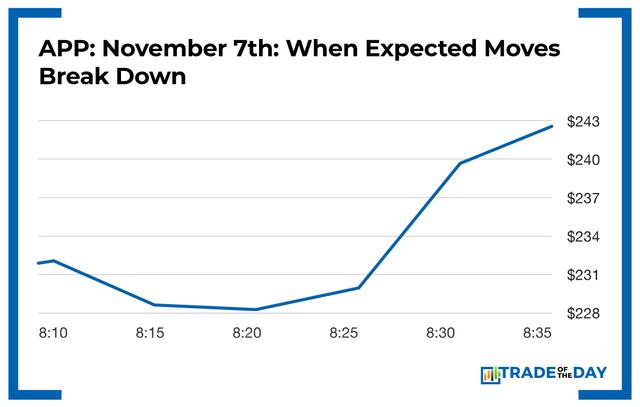
The Market Maker Pain Trade (This Is Where It Gets Interesting) All right, so here's how this actually works. When market makers price options before earnings, they're essentially making a bet on volatility. They calculate an expected move - in APP's case, about 12% - and they price those options so that if the stock moves exactly that amount, nobody makes money except them. They're selling premium to both call buyers and put buyers, collecting that sweet time decay. It's a beautiful business model when stocks behave predictably. But when a stock beats by 1.5 times that expected move? Holy moly, that's when everything falls apart for them. APP opened at $230, hit $257.43 during the session. Think about the market makers who sold those 255 calls. They probably sold them for pennies, thinking there was almost no chance APP would get there. Suddenly they're sitting on massive losses and they HAVE to hedge. They can't just sit there and hope it comes back down. They have to buy stock or buy calls to cover their short positions. That creates forced buying pressure that can push the stock even higher. Here's the Exact Numbers I'm Watching This Week So while everyone's focused on guidance and estimates, I'm watching for these specific thresholds. Here are the implied moves for the big earnings coming up: NFLX: 7.59% - I need to see this thing move above 11.4% to get excited. Netflix has been all over the place lately, so if they beat big on subscriber numbers, this could really run. TSM: 5.39% - Watching for 8%+ moves. Semiconductor earnings have been wild this year, and if they give strong AI guidance, market makers could get caught off guard. AA: 7.98% - Need to see 12%+ to get interested. Alcoa's a smaller name but when commodities move, they really move. ASML: 6.27% - Looking for 9.4%+ moves. This one's interesting because it's such a key supplier to the chip industry. WFC: 4.58% - Watching for 6.9%+ moves. Banks have been boring lately, but if they surprise on net interest margin or credit quality, this could work. These aren't predictions - these are just the mathematical thresholds where market maker pain starts to kick in. Most of these will stay within their expected ranges, and that's fine. I'm not trying to bat 1.000 here. My Actual Game Plan (Position Sizing Matters) Here's what I'm actually going to do. If any of these beat their expected moves by 1.5x, I'll throw small limit orders at out-of-the-money calls for the following week. Not market orders - limit orders, because the spreads are going to be terrible in the first few minutes. I'm talking about risking maybe $200-500 per trade, not betting the farm. The beauty of this setup is that when it works, it can pay for a lot of losers. But you have to size it right because most of these plays expire worthless. The Real Risk Management Part (This Is Important) Let me be clear about something - this is speculation, not investing. I'm using money I can afford to lose completely. When I say "small position," I mean it. This isn't rent money or retirement savings. The other thing is timing. These moves happen fast. If you're not watching the market near the open, you're probably going to miss the setup entirely. And if you chase it after the initial move, you're probably going to get burned. I think the sweet spot is getting positioned within the first 30 minutes of the market open, taking profits on half when you double your money, and letting the rest ride as a "free" trade. What Actually Drives These Moves The thing that gets me excited about this setup is that it's not really about the fundamentals of the company. It's about the mathematical mechanics of the options market. When a stock moves 1.5x its expected move, you're essentially breaking the model that market makers used to price those options. They have to scramble to hedge their positions, and that creates momentum that can feed on itself. It's not guaranteed - nothing in trading is. But it's a repeatable setup based on market structure, not trying to predict whether a company is going to beat earnings by 2 cents or 3 cents. Look, if you want the full breakdown of how I spot these setups and time the entries, I put together a training that goes way deeper than I can in an email. But the basics I just shared will get you started. YOUR ACTION PLANUse these exact thresholds - NFLX needs 11.4%+, TSM needs 8%+, AA needs 12%+, ASML needs 9.4%+, WFC needs 6.9%+. Risk small amounts, take profits when you have them, and don't chase these setups with money you need for anything else.
| 








Tidak ada komentar:
Posting Komentar