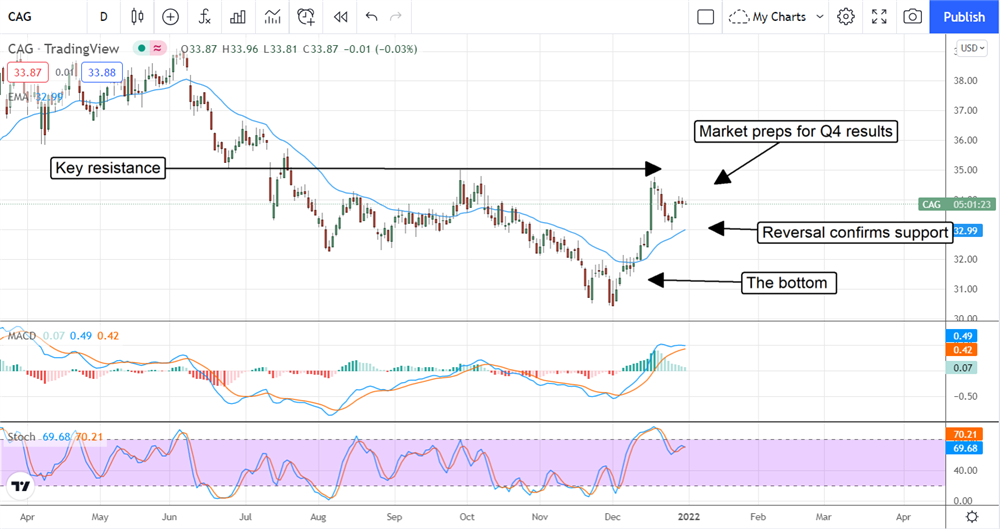
Happy New Year! Santa Claus extended his rally last week leaving the S&P 500 (NYSEARCA: SPY) at a new all-time high. The question now is whether the market will follow through on the move or not. The technical picture is promising but there is always the risk the holiday movements were not in line with the fundamental outlook. Assuming the market does follow through, we see the S&P 500 closing out January about 250 points higher and that is good news indeed. As they say, as goes January so goes the rest of the year. A solid move higher in January could lead the market even higher by the end of the year. Inflation remains the biggest concern for the market, not only for its impact on earnings but also in regard to interest rates and their impact on the economy. The CME’s Fedwatch Tool, coincidentally, is pricing in the most aggressive outlook we’ve seen in quite some time. The tool assumes the first hike will come in March now versus the June timeframe it was predicting just 6 or 8 weeks ago. The tool suggests there will probably be two 25 basis point hikes by May and possibly three by June. The way things are going, we won’t be surprised to see the first hike come in March and for it to be an aggressive 50 basis points. The really scary thing about the interest rate outlook is that the FOMC is so far behind the curve that raising rates now might make inflation worse. Demand is high, so high in fact, that backlogs continue to grow. We know that this business activity needs to happen in order for the global supply chain to get back into alignment. In that regard, raising interest rates will absolutely make it more expensive to do business but it is very questionable how much higher rates will slow business down and the ones to pay for it all will be the consumers. Things to think about. Something else to think about is what kind of impact, exactly, is Omicron going to have on the economy? Omicron is spreading like wildfire but the messages we are getting are so mixed as to make us wonder what the heck is going on? Omicron is spreading but is much weaker and less virulent than previous versions. It is expected to overtake Delta and possibly provide enhanced resistance but also cause worse problems than before? The CDC says we can quarantine for half the time previously but also says no one should be cruising which makes no sense, and then there is the White House which can’t decide if there is a national solution or not. The takeaway for us is that COVID is still here and may cause stocks to falter but, if that happens, it will most likely be a buying opportunity. The Economic Data Last week’s economic data was expansionary but without luster. The home prices index rose another 20% which is good news for homebuilders but bad news for everyone else and another sign of rampantly increasing inflation. On the flip-side, Pending Home Sales data was weak, possibly because of rising prices, and fell more than 2.0% versus an expected gain. The jobless claims data was good, holding near multi-decade lows, but there is still no sign of what happened to those millions of American’s who fell off the unemployment roles in September. The best news, though, was the PMI which points to an acceleration of business activity if not hiring. This Is What To Expect In The Week To Come A Busy Week Of Economic Data This is going to be a very busy week for economic data with at least 10 major reports due out including the NFP and FOMC minutes. The FOMC Minutes will be even more important than usual with the committee having increased the taper and on track to raise rates well ahead of any previously indicated timeline. The NFP, along with the rest of the labor bundle, will be very important for job creation, unemployment rates, labor force participation, and wages. While we expect to see solid job creation, a decline in unemployment, and increased wages it is the participation data we are interested in. The U.S. labor shortage situation is not likely to improve without an increase in participation and the number of available employees. Other data within the labor bundle we will be watching include the ADP report, the Challenger report on layoffs/hiring, and the JOLTs report on job openings. Other data of importance this week is the Chicago PMI, both ISM releases, construction spending, and factory orders. Earnings Season Gets Underway While the Q4 reporting cycle technically got underway a few weeks ago, and it’s still about 3 weeks before the true peak of the season, the cycle starts in earnest this week. There aren’t a lot of reports on tap but there are noteworthy early-reporting names in the consumer staples, consumer discretionary, and basic materials sectors. The consensus estimates have barely budged over the past week leaving the outlook unchanged. We’re still expecting a slowdown to about 21% YOY growth (consensus) with actual results expected to outpace the consensus by 1000 to 1500 basis points. The risk here is that earnings growth will not outperform as much as expected and that forward outlook will take a hit as well. The forward outlook is unchanged this week as well. Earnings growth is going to slow to the low single-digits in the first half of 2022 with a possible acceleration in the back half of the year. Our Focus List For The Week There aren’t a lot of names reporting this week, not confirmed anyway, and they are all in the back half of the week. The first on our list is RPM International (NYSE: RPM), manufacturer of paints, specialty coatings, and manufacturing/construction supplies, which reports on Wednesday morning. This report is very important because RPM International’s business serves both business and consumer demands and its products are an important input cost to virtually all projects. The company has seen strong demand across all segments if impaired by supply chain, logistics, and inflation. While the results are important, we are interested in the inflationary pressures, earnings, and if another round of price increases is on the way. Richardson Electronics (NASDAQ: RELL) reports on Wednesday evening and may also impress the market. The company makes a variety of equipment for microwave, electronic, and display purposes services a wide range of industries including diagnostic and healthcare. The company’s business barely experienced a hiccup during the pandemic and it has been growing sequentially ever since. With demand for electronic components systemically high, we see this company’s stock moving up to and above the $15 level by the middle of the year. Conagra Brands (NYSE: CAG) reports on Thursday morning and should exceed the market’s expectations. The company has been working hard to reposition its portfolio for the last few years and has seen a sustained increase in business since the pandemic. The analysts are expecting sequential and YOY gains that we view as cautious. Shares of Conagra Brands hit a bottom in early December and have since effected a nice-looking reversal that could take shares back up to the $40 level by mid-year. That would be worth about 17% upside not counting the safe 3.7% dividend yield. This is the chart of the week.
 Lamb Weston (NYSE: LW) reports mid-day on Thursday and may give the market some good news. The analysts are expecting a sequential and YOY increase in revenue but a tepid increase in light of the restaurant reopening. Restaurant business picked up noticeably in the period and should show up in Lamb Weston results. The question is whether the results and earnings will be enough to justify the high 40X earnings the stock is trading for. At this level, it is the most highly valued consumer staple and pays a measly 1.5% compared to a range of 2.5% to 4.5% for the rest group. WD-40 Company (NASDAQ: WDFC) reports on Friday morning wrapping up our focus list for the week. The company is expected to post $129 million in consolidated revenue for a sequential, YOY and two-year gain. The risks for this company include possible revenue impairment due to supply chain issues and tightening margins. The upshot is that increased ad-spend and marketing in the previous quarter are likely to have a positive impact on results as well. Until then, remember the trend! Thomas Hughes
Questions or Comments Click Here | 

Tidak ada komentar:
Posting Komentar